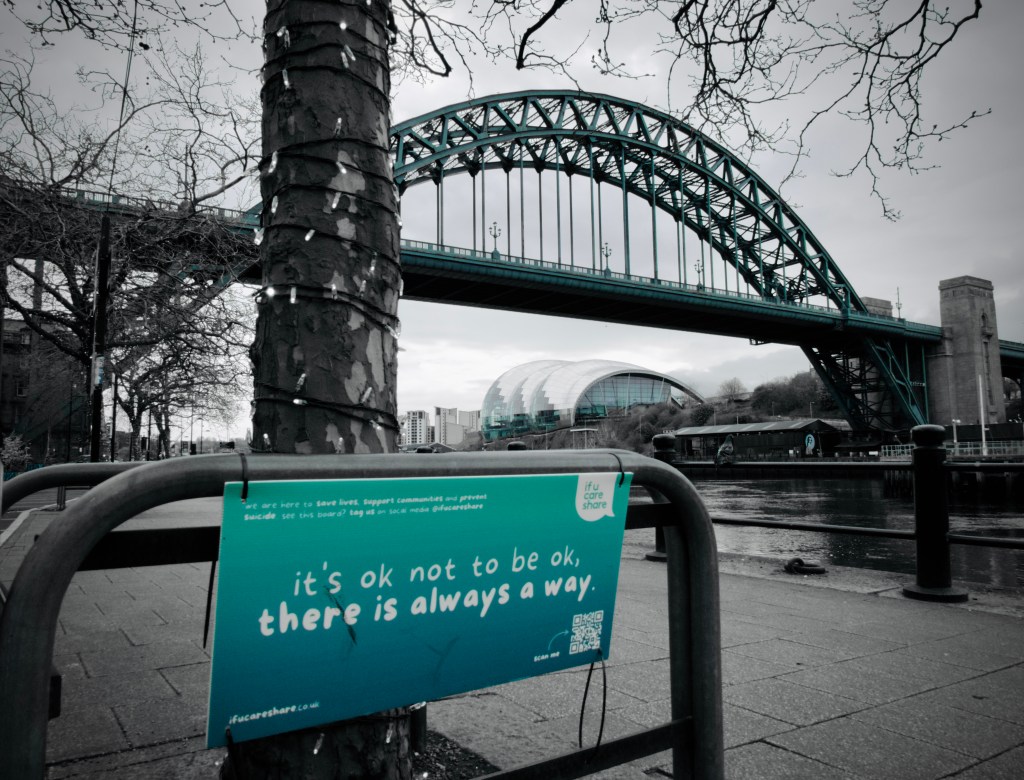
Tag: depression

  • Hello darkness……friend….not monster.

    Hello darkness……friend….not monster.

    Hello darkness, my old friend. 

    I wrote in the first line of my journal this morning, as if I was channelling the ghost of Simon and Garfunkel and trying desperately not to rewrite the song as the outpouring of what I was feeling. I wanted a unique feeling. Not some old crooners giving it some and im just the same as them. 

    Because, the darkness monster appeared to me as I lay under the duvet just seconds after I clicked the snooze button. 

    It hadn’t appeared for a while. Actually I thought, that it may have gone forever. But. 

    No. 

    It appeared. 

    Inviting me into itself as a companion of negativity. 

    Wanting to envelop me again. 

    And before you say it, today is not a ‘back to work’ monday morning. 

    Today is actually the first of three days off when I want to do some writing and crack on with the book im in the middle of. 

    For ten minutes I let it speak to me. 

    It wanted to remind me of my smallness

    It wanted to remind me of my shame

    It wanted to remind me of how I haven’t actually written ‘the book yet’ – failings..

    It wanted to remind me that it would be easier to not bother and avoid the disappointment

    It wanted to remind me that there were easier ways to spend my day

    It wanted to tell me that it was protecting me

    It wanted to still be important… 

    It wasnt lying to me, not quite, it was giving me an easier way out…. 

    Appearing as a monster. And I felt small.

    I shaved, showered and put on clean clothes, as a defiant act of self care, and feeling my body, and in the moments of waiting for the kettle to boil for coffee, I wrote and wrote, using black pen for the darkness and pink for me. Pink for my soft heart that wasnt angry, wasnt frustrated by the return….. but wanted to hear even more. 

    I asked my darkness what it wanted, and what it was scared of

    I asked it for its message, and what it was alerting me to

    I asked it to tell me the truth. 

    And I realised that the visit this morning was brought about by a number of things, that started yesterday, when I struggled to write, and gave myself into ‘just having a lazy day watching you tube and sport’ until I got to the evening, where I read a bit and chatted to my partner. 

    Because although I find that the mornings have been a time for me where my darkness friend arrives often, it has mostly only been in the last five or six years when I have been open, safe, and able to feel it. Before this time I had underlying depression that was just constant and masked, as I hid everything away behind a stony mask of survival. Depression was in effect a constant. 

    And then I watched a bit of a documentary over breakfast. And walked into town. 

    And as I walked I realised that maybe, maybe we still dont talk about depression anything like as much as we talk about anxiety. Or maybe we do and I just dont read, or hear about it. 

    And if we do talk about depression it’s rare theres a conversation about how masking it makes it worse, and how for so long it can be hidden. 

    Last week was international suicide prevention day, and that is one easy way out from all the pressure, or all the voices of being scared, unsafe, fear and living a life masking it all, trying to stay strong, trying to be strong for others, with often no support. This is not just a men issue, but it mostly is, and no job, vocation or career is immune from it. Depression is everywhere. 

    In Johan Hari’s book ‘Lost connection’ he writes about the seven things that he realised that we have lost connection with, that all increase depression. I realised I had two of them all my life without realising it. (writing about them here ‘shining a light on my depression’) 

    They are 

    Lost connection with Meaningful values – Junk food for the soul is what Hari regards the rising of the media and cheap capitalist values. 

    Childhood Trauma – if that pain feels too large to deal with, then it’s haunting. 

    Nature – too much screen time is making us sick….the trees heal, touch them. 

    Purposeful work – as everything is standardised, AI is a threat… 

    Dreams and future – survival mode is a present reality that makes the future seem impossible, time is compressed

    Status and respect – Understanding who we truly are, and respect for ourselves and others… 

    Each other/Community – For some there is more connection and yet more isolation within technological spaces, yet depth of community and conversations can often be lost….(im writing this in a coffee shop and its lovely watching people have in-depth conversations with each other) 

    I summarise all of them, and writing them from memory. I could add a number of things to them, and in a way connection is another word for reverence, to have connections with these things is to pay reverence to them, to realise their importance and dig deep into the relevance and intention to work on them – all very difficult when the darkness monster wants to remind us of being small, alone and afraid. (and the anxiety friend helps out with these too…too often) 

    I didnt wake up this morning, or even want to spend any time writing about depression or me or trauma or recovery or healing today, in fact im almost trying not to. 

    Yet I have a life of survival and a life of masking depression and anxiety, and I didnt give in to the easy option of ending life when I was 9, or 34, 39 or 44, when I was close to, and just felt this was important today. To own it, write about it. 

    The real. 

    So here I am, and it’s whats burning to come out today. Writing through the feelings, writing through the process, writing vulnerability into being. 

    Hello darkness my old friend. 

    Friend. Thank you. 

    And then I reminded myself, that I am. 

    I am not the small thoughts

    or the fears….and there is a gift in the voice

    a seed of truth. 

    To remind myself. 

    Of my gifts, my hope

    and the world opening up and waiting for me. 

    Yeah ive now gone full circle, from Simon and Garfunkel to The Greatest Showman. 

    I dont think we talk about depression enough. 

    I dont think its as easy as ‘just talk to someone’ 

    It’s clinging on to something where the rock bottom hits. 

    Its not just a you issue, there are wider factors, there always is…

    It’s a you issue for you though and you, and I are more important than to give in to it all. 

    Darkness is a friend. (as is anxiety) 

    Not monsters. Friends.

    Trying to not feel them, or always feeling them…..reveals there is something wrong. 

    And whilst you’re alive there is a way out, change is always possible. 

    The battle between thoughts and feelings, good and bad voices, demons and angels was a lie, a lie to create shame and fear and dependence. 

    Oh and yes sometimes I would love to not feel all these things, and sometimes they feel yucky and raw and debilitating and yet, the alternative of not feeling, was not living. I cannot go back, and I dont want to. Life is journey paved with love, even if the darkness friends sometimes want to pop in and have a conversation, through tears they are met with love, and sometimes we’ll walk together. Me and my darkness and anxious friends.

  • Breaking the Silence: Men’s Mental Health Matters

    As men, we’ve been conditioned for generations to believe that strength means suppressing our emotions. We’re told that being tough, stoic, and unshakable is the ideal. We’re encouraged to “man up,” to push through pain, to avoid vulnerability, and to believe that needing help is a weakness. This outdated notion is not only damaging to our mental health, but it’s also limiting our potential to live fulfilling, balanced lives.

    The reality is that mental health struggles don’t discriminate based on gender, and emotional pain doesn’t go away by ignoring it. If anything, it grows in silence. More than ever, it’s time for us to dismantle the toxic expectations surrounding masculinity and embrace the truth: it takes courage to heal.

    Here, I aim to create a safe, open space for men to address their mental health, explore their emotional well-being, and heal from the burdens that have been weighing on us for too long. Today, I want to share why this journey is crucial and how embracing healing is not just a form of self-care—it’s an act of strength.

    The Invisible Weight: Why Men Struggle in Silence

    For decades, mental health awareness has been dominated by female voices, and while this is an important conversation, the men’s mental health crisis often gets overlooked. According to a 2019 report from the Mental Health Foundation, men are three times more likely to die by suicide than women, and nearly 75% of suicides are committed by men. These numbers are not just statistics—they’re real lives lost to a silent epidemic.

    Why does this happen? Why are so many men silently suffering, often without reaching out for help?

    The answer lies in the societal pressures and deeply ingrained stereotypes about what it means to be a man. Many men grow up in environments where vulnerability is shamed, where emotional expression is seen as a flaw, and where “being a man” means never showing weakness. As a result, men often bottle up their feelings, ignore their emotional pain, and repress their mental health struggles, leading to a build-up of unresolved issues.

    But this approach doesn’t just lead to tragic outcomes; it also prevents men from achieving true emotional maturity. It stifles personal growth, strains relationships, and isolates men from the support networks they desperately need.

    The First Step: Acknowledging the Need for Healing

    It’s impossible to start a healing journey if we don’t first acknowledge that something needs to change. And for many men, that means recognizing the emotional pain they’ve been carrying and giving themselves permission to feel.

    The healing process begins with self-awareness. Whether it’s experiencing anxiety, depression, trauma, or just a general sense of emotional numbness, the first step is often the hardest—admitting that we are not okay. This can be a daunting experience, especially for those who have been conditioned to believe that “real men” don’t feel or express weakness.

    But the truth is, acknowledging that we need help is one of the most courageous things we can do. It’s a sign of self-respect, a commitment to bettering ourselves, and an act of self-love. It says, “I deserve to be well,” and, “I’m worth the effort it takes to heal.”

    The Power of Vulnerability

    I know that for many men, the word vulnerability carries a lot of weight, often invoking fear or discomfort. We associate vulnerability with being weak or exposed, but in reality, vulnerability is an incredible source of strength.

    Think about it: vulnerability is what allows us to form deep connections with others. It’s what lets us be real and honest, not just with ourselves, but with the people we care about. When we embrace vulnerability, we open ourselves up to healing, growth, and authenticity.

    Opening up about our feelings—whether it’s to a friend, a therapist, or a support group—doesn’t make us weak. In fact, it does the opposite. It takes immense courage to confront and express the emotions that we’ve been taught to hide. Vulnerability fosters trust, self-acceptance, and meaningful relationships. It helps us release the burdens we’ve been carrying in isolation and invites others to do the same.

    Im hoping that by sharing my story, I’ve encouraged men to lean into vulnerability. It’s not about airing our weaknesses—it’s about recognizing our humanity and giving ourselves the space to be imperfect.

    Seeking Help: Therapy, Support Groups, and More

    The road to healing is not one we have to walk alone. In fact, seeking help is a crucial step in the journey. For men, this may mean attending therapy, joining a support group, or talking to trusted friends or family members. The stigma surrounding therapy for men is slowly changing, but it’s still a barrier that many men face. There is a misconception that therapy is only for those who are “broken” or “weak,” but that’s simply not the case.

    Therapy is a tool for growth, not a sign of failure. It’s a space where we can explore our emotions, process past trauma, and develop healthier coping strategies. It’s a place where we can challenge the harmful narratives we’ve been told about masculinity and build a more balanced, authentic version of ourselves.

    Support groups can also be an invaluable resource. Many men feel isolated in their struggles, thinking they’re the only ones going through difficult emotions. But when we connect with others who share similar experiences, we realize we’re not alone. Support groups provide a sense of camaraderie and encouragement, and they help men normalize the conversation around mental health.

    The Benefits of Healing: Personal and Relational Growth

    Healing isn’t just about alleviating pain, often its about facing it—it’s about transforming our lives for the better. When we take care of our mental health, we improve our overall well-being, which has a ripple effect on all areas of our lives.

    1. Emotional Resilience: When we work through our emotional challenges, we build the resilience needed to face future stressors. Rather than feeling overwhelmed or defeated, we become more equipped to handle adversity with confidence and emotional maturity.
    2. Stronger Relationships: Healing allows us to show up more fully in our relationships. We become better partners, fathers, and friends when we prioritize our emotional well-being. By understanding ourselves more deeply, we can communicate better, set boundaries, and foster healthier connections.
    3. Physical Health: Mental and physical health are deeply connected. Chronic stress, depression, and anxiety can manifest in physical symptoms like headaches, digestive issues, and fatigue. When we address our mental health, we’re also improving our physical health, leading to a more vibrant and energetic life.
    4. Purpose and Fulfillment: Healing helps us reconnect with our sense of purpose. It allows us to align our lives with our values and passions, leading to a more fulfilling and meaningful existence. When we take care of our emotional health, we can pursue our goals with clarity and motivation.

    Taking Action: How to Start Your Healing Journey

    If you’re ready to embark on your own journey of healing, know that you don’t have to have all the answers right now. The process can begin with small, intentional steps:

    • Speak to a professional: A therapist can help guide you through your healing journey with personalized support. Look for a therapist who specializes in men’s mental health or general emotional well-being.
    • Open up to someone you trust: Sharing your struggles with a friend or family member can help alleviate the weight of silence. Even if it’s just starting with one conversation, it’s a powerful first step.
    • Join a support group: Finding a group of like-minded men who are on a similar journey can offer camaraderie and solidarity. You don’t have to face your challenges alone. Andy’s Man club is one in the north east.
    • Practice self-care: Healing isn’t just emotional—it’s also physical. Take care of your body by exercising, eating well, and getting enough rest. Self-care routines create a foundation for mental and emotional healing.
    • Educate yourself: Read books, watch documentaries, or listen to podcasts about men’s mental health. The more informed you are, the better equipped you’ll be to navigate your healing journey. I can recommend a lot in the resources section on this blog.

    Final Thoughts: Reclaiming Your Power

    As men, we’ve spent far too long holding onto the lie that emotional pain should be hidden, ignored, or suppressed. But healing is not only possible—it’s essential. By embracing our vulnerability, seeking support, and taking responsibility for our mental health, we can redefine what it means to be a strong, resilient man.

    Healing is an act of power, not weakness. It’s time for us to break the silence, step into our full humanity, and heal—not just for ourselves, but for the generations of men who will come after us. Often its crisis that takes us to this point, or the desperate calls of a loved one to face things, maybe it’s time for you, to lean in to the possibilities beyond and break up the surface cracks and find wholeness underneath, beyond the pain.


    Remember: You are not alone in this journey. You are worthy of healing, and it’s never too late to start.

    Confession. This article is 90% written by GPT, with a few additions. I genuinely wanted to see what it would write if I asked it to write a 1500 word piece on Mental Health and Men. So here it is. Whether it’s from AI or from me, the message is the same though.

    Your Mental health matters men, and you change before you break, or it’s too late. Do it for you, and all you love.

  • Hello again Despair; meet love.

    Hello again Despair; meet love.

    Oh Hello

    Not darkness my old friend.

    But Despair.

    I saw you.

    I heard you.

    Sneakily arriving when my guard was down.

    When tiredness and exhaustion had depleted me

    And reminders of trauma hurt like the touching of the electric fence.

    And everything span.

    You found a way in when unexpressed anger over powered

    And I had no defences.

    Thanks. Nice. Am so glad you showed up.

    Thank you for your honestly.

    Giving me the path, showing me how I could soothe myself.

    Convincing voice that I was weak, alone and it wouldn’t matter, that I was small all over again.

    Despair, the friend who’s been close since childhood.

    Since desperate moments in bedrooms.

    When suicide was a conceivable option

    But, it’s been a while since I sensed your voice.

    Until the last few days.

    When reminders came back.

    Big.

    As did the swirl.

    the headache.

    The confusion.

    Trauma tired. Small.

    I heard you trauma despair,

    I heard you.

    But this time, for the first time.

    I heard you in that moment.

    And gave you airtime.

    And told you thank you

    Loved it, for protecting me before.

    For it used to be despair in the cacophony of depression, as if constant down with despair blips.

    But this time. Despair made itself known from a place of general positivity.

    New normal is a loving powerful me.

    And I decided that it needed to be loved.

    And not shamefully hid, but loved in the open.

    Talked to, heard and for despair to realise.

    That it isnt me.

    But it used to lead me, and I didn’t care enough to fight it.

    But this time, despair, I met your pain with love.

    And trauma you didn’t overcome me, not this time.

    I will hold you, and my arms will love you.

    I am bigger than you and love will always melt you away.

    Thank you for your visit despair, it’s time you were released, it’s time to let you pass through me.

    Linger no more.

    Goodbye this time despair, know you’ll be loved next time too. If I see you again.

  • Loving discomfort

    I used to suppress everything, so I didn’t feel anything

    Get through it

    Survive it

    Bounce

    Close off my heart, live a shrouded life.

    Any discomfort was barely even felt

    Or felt in silence, private and…

    then pushed through,

    and receive the weight , the noise of my own destructive self talk.

    Trauma voice shouting internally.

    No heart open to love myself, so no love to do its work.

    But I realised over the course of the last year,

    of journaling words of self love everyday.

    That there are more aspects of life that I now talk more lovingly to.

    Because, talking lovingly to myself is actually a free choice. You can do it, but like me, I was too scared to.

    I didnt want to believe that I actually was lovable, incredible, brave, courageous, powerful.

    But then I did.

    And something I noticed, is that when I talked kindly to myself…

    I didnt beat myself up that often

    I could tell myself that I had done well in what I was doing

    I could feel proud of myself

    All completely unconditionally. A choice.

    Loving the discomfort.

    Thats been tough.

    Because often I forget, or I am tired, or there’s a new ‘thing’ that appears, a feeling or situation, and it swipes me.

    Sometimes I berate myself for feeling what I feel. it’s like I think I shouldn’t feel anxiety, or depressed, or lonely even after doing all this work.

    Maybe I dont think I should be triggered.

    But thats not what it’s about.

    It’s these moments, where the work helps to self regulate. It’s these moments to notice the feeling. It’s these moments to feel them.

    Sensing it.

    And to love it.

    In the moment.

    Because they stem from wounded parts. They are feelings, angels of learning, and opportunities to be loved and held.

    Discomfort needs to be loved and not berated

    Discomfort needs to be loved and not criticised

    Discomfort needs to be loved and not ignored or suppressed

    Discomfort needs to be held, in your open heart

    And know that its ok, its trying to protect you

    And love you may have for someone else, rightly, turn it inwards, protect your energy and fill that discomfort, that pain with love from within. Talk to it as a friend. Ask. Love. Breathe love into it.

    Because then healing arrives from the inside out.

    Love does always win, truly.

    Love the discomfort, and then be transformed.

  • Careful, the universe might give you what you wish for.

    Dangerously there were two words that I started 2023 with.

    It was as if, they were the words that were about to shape my life, weirdly.

    One of the words I wrote about, a little bit. The other I didnt.

    I wasn’t a bit fan of ‘manifesting’ or ‘goal setting’, for a mixture of reasons, one felt too charismatic and dare I say it, American, the other I realise now was because of inbuilt depression.

    Want to know what the two words were?

    (I guess thats the point of this piece)

    One of the words was Happy.

    The Other was Surrender.

    And… little did I know what was about to happen in the year.

    Because, I started the year in quite a good place.

    But it sort of felt just a bit fragile, I was having happy moments. I was having moments of ‘overcoming stuff’ that in the day to day I was enjoying the bliss of this, the wash of self love, and also beginning to feel a bit more me, and a bit more confident.

    Yet, the early confidence of 2023 was fragile. I could tell. It wasn’t matched with self belief, it wasn’t matched with a sense of inner wholeness, it wasn’t confident.

    As I said, the words were Happy, and Surrender.

    From April until August 2023. I crashed.

    Big time crashed.

    I had fought a fight and lost badly, and the inner voices returned.

    And it felt so so dark.

    Had I gone too soon with trying to be Happy?

    No.

    Did I have more healing to do?

    Yes

    Was the universe shaking it all up so that I could Heal even more?

    Oh fuck yes.

    Was it hard. Absolutely.

    As bleak and as dark as anything before. As anything since I was 9. The year I had to shut out the voices.

    But now I heard them again.

    Happy and Surrender.

    really?

    Happy and Surrender.

    Surrender and Happy.

    It’s so hard to explain now, but the spiralling fall that was taking place was debilitating.

    Happiness felt like an unachievable illusion

    Surrender felt like falling, failing, giving up.

    I was treading water with lead bricks attached by ropes to my feet.

    Walking a tightrope that was on fire

    Bleak, Dark, humiliation and all the feelings. All of them.

    And yet.

    And yet, I also realised at the time, with gritted teeth, that the voices, the inner peril was being revealed to me so that I had no choice but to deal with it.

    No choice.

    After 6 months of not really writing to myself, I re started journalling again, when I say journalling, I mean writing out the rage, the hurt, the anger, the pain, the feelings of humiliation, little James’ pain. This was the beginning of starting to write to little James, writing that tentatively started to shape the book im writing.

    I had to ask for help.

    I had to accept, surrender even, that I needed help.

    Everything was triggering me. Everything.

    I could tell how self absorbed I was in my own damaged head. In my own woundedness.

    Help arrived in a number of ways.

    Yes, professional help in terms of beginning therapy again. But also finding a safe space to write and give myself distance from the places that felt unsafe or too draining.

    The raw path of vulnerability opened up the beautiful. I noticed the gifts of the universe in response. I began to feel held.

    Happy and Surrender.

    Strength from surprising places, notably from within. One Vulnerable step at a time.

    Some of the breakthroughs might warrant a whole piece on them.

    At that wasn’t really the point of this piece, the point was that 15 months ago there were two words that seemed to be announcing themselves to me at the beginning of the year. Happy and Surrender.

    And the relationship between the two, in my healing process in the last 15 months is quite astonishing.

    Surrendering to the darkness did not mean giving in, giving up, or believing the voices, even if they were loud and I felt terrified, small and humiliated.

    Surrendering meant accepting that those inner voices were the consequence of pain and a damaged wounded childhood and I needed again to love those wounded parts, listen, and be open to whatever the path might be, navigating through them.

    Surrendering to the path through the darkness and slowly but surely holding myself in love as the path was being walked on slow step by slow step. A path of self-compassion and warmth as the anti-dote to self hatred, blame and criticism.

    Happiness was a risk. It still feels like a risk, a tender shoot to love and care for.

    A new toy to protect.

    Easier to talk about pain, shame and darkness – that isn’t going to be stolen.

    Happiness is fragile. Happiness feels conditional. Happiness requires surrender.

    Because, after all, what was the point? What was the point of wanting to be whole, healed and better? Just to exist and survive? Just to write about it and get the views? Just to stay stuck in it?

    I dont think so.

    Happiness and Surrender – what did I need to surrender to, in order for there to be inner happiness in my heart, soul and mind?

    A happy mind? imagine that… not an over thinking, over sensitive, triggered one.

    And, 4 months since the end of regular therapy. 9 months of the slow step by step inner healing process (of this phase of it).

    Whisper it quietly, or shout it from the rooftops, a deep sense of Happiness, of Joy even, has found me, a kind of clarity and strength and peace in heart, soul and mind, that hasn’t been my life experience ever. It’s weird, so so weird, but incredible all the same.

    Happiness and Surrender… You dont always get what you wish for, at least not in the ways you might expect, but sometimes the universe, the loving mystery of the universe has it, and it has you too.

  • The Power of Jet:Lag (the game)

    There was a time in July/August of last year when I was going through a pretty significant mental spiralling, down down and down. I was plagued by the bleak thoughts of self criticism, self sabotage, blame and self loathing, all things I realise I have been carrying since childhood, and all things triggered by events involving those people that brought all these things back to the surface (stuff that will remain private) . I would go as far to say that it was one of my biggest spirals, as instead of feeling numb to the pain and ‘I will survive’ which was my previous default, now I was feeling the feelings, and the voices were pretty strong.

    I was digging deep, every day, sometimes every hour, felt like a struggle to get through. I knew a number of things though, one was that whatever I was going through was an opportunity for it to be revealed and for me to heal from. The other was that I had to remember in the midst of it all the tools that I had learned so far.

    But my mind was in overdrive. Serious overdrive.

    It felt like everything I was doing was in some way connected to the trauma, and so I was finding it a swirl just to try and ‘sit with my feelings’ and I didnt feel safe or strong in myself to appeal to the inner voice of sheer panic and pain.

    I have written before about how I have needed to switch off from things, such as the news or TV (I am yet to watch or listen to the news on a TV or Radio in about 5 years), but what I was finding was that I was becoming seriously self absorbed, in a frightened alll consuming, can’t stop thinking, worrying, being anxious kind of way.

    It was around about this time that I started to write my book. It was a different kind of writing to what I had been doing before, and it wasn’t just the process of writing but also finding a lovely cafe at Waterstones Darlington meant that I was in a different environment, around non threatening strangers and friendly safe books, all going a tiny way to giving my mind a break.

    But this in itself, though creative, and positive, also involved energy, and though I found I could write at times, it could also lead to frustration when I found I couldn’t write or my mind was struggling to ‘un-focus’.

    And thats where Jet:Lag comes in.

    For much of the last 5 years I have mostly watched You Tube for my ‘entertainment’ . I struggle to watch films, and there’s something about the unfiltered, human creativity on you tube, from its documentaries, and human interest stuff that I like. My first encounters with it were to listen to music when I was studying, and in 2017-2018 I found railway You tube and especially people like Geoff Marshall and ‘All the Stations’ was a particular personal relaxation therapy gift, back in the day.

    In the midst of the swirl of last year I was finding that I was struggling to find and have to desire to watch or read anything that was thoughtful or even involved learning , my brain had had enough, and yet I didn’t feel I could give myself permission to do nothing, honestly writing this now, but if you have been through depression and anxiety you will know what its like, its like the voices of criticism and responsibility not allowing me to do anything.

    I had just watched a few train based challenge videos on YT and it was now suggesting that I might like what looked like a fairly goofy channel called ‘Jet lag; the game‘ in which it looked like they did races and challenges across various countries.

    I dont remember the order or exactly what happened, but after a few days of noticing this suggestion I clicked it.

    And then on one Saturday in late September (I think) I did nothing but watch four or five of the seasons and challenges. Three geeks (and often a 4th geek joining in) doing silly challenges, in competition, including travel and having fun, hard earned and tiring fun, with a whole load of jeopardy and unscripted coincidences.

    Nothing else. No cleaning, no social media-ing, no writing, just making myself some food, and sitting watching Jet Lag. Nothing that required losing emotional energy, and yet, something that in doing ‘nothing’ was also restoring it, personal introvert time- yet but without the necessity of trying to ‘work stuff out’ or ‘process things’ or ‘understand what’s going on’ just rest. A gap. A rest.

    And it was the mental break and gap my mind needed, one of the many things, but for one day this was it.

    I can’t quite work out what the ‘correct’ balance it, but there is one, when I felt in the mental state that I was in. It had to be safe – so no heightened drama that I could be invested in or be triggered by abuse – it had to captivate in a way that meant I could be invested in it (its a competition, but done in a v friendly and respectful way), it was also creative and funny too. At least, it was for me. I could get lost in it, without it overwhelming me, I could enjoy it and appreciate it, and it could give my mind something to be engrossed in that didnt require personal internal work or feeling responsible. Im not sure if I have described the balance right, but I know that other things I was trying to watch or do or think, were either too open (going for a walk and processing), watching sport theory (there’s only so many times I can be captivated by Arsenals pressing system, and my team Man Utd, are too triggering, too many sociopaths involved too much drama on top of more drama) and somethings I had relegated to ‘boring’ like food review shows, only so many times I could watch someone eat.

    Some times it’s important to find the thing. Or maybe, that thing in that moment finds us. I did not realise quite how ok it was to just allow myself to be not thinking and trying to process stuff. I am in a different place now, 6 months on, and im happy to sit and journal and colour, but im not sure I could have done that then.

    For one almost entire weekend, I did nothing but watch Jet lag; the game, and it was the gap my mind required to not think, but just to curl up on the couch and just be. When we’re in the middle of ‘the thing’ it can be difficult to know what the thing is that we need, for me it was something wholesome and fun, safe and non threatening, but captivating too. It was me saying to my mind, back off, i’m in charge and i’m going to just watch this today, it was a gap in the mind.

    Sometimes attending to our mental needs requires a whole load of things, one is to be so aware of what we are consuming and the energy of this on us, but also being able to give ourselves the mental power to tell our overactive minds to back off and rest. It could be something very different for you, and there are times when it can be something very different for me too, it can be walks and photography, it can be travel and writing, but on that weekend 6 months ago, what I needed was 3 geeks doing challenges, travelling and competitions, and the pure captivating enjoyment of fun, it may seem like nothing, but it retrospect it was so part of my healing process from such a dark period of my life.

    (it goes without saying that I am not suggesting that watching Jet lag in a time of anxiety or depression is the only thing you should do to alleviate this, I was also about to start therapy also)

    Talking about my book, if you would like to support me, you can do so at this link here, where you can give a one off or support me monthly as I write a book for boys and feelings. Thank you

  • Shining a light onto my Depression

    Its ok to not be ok

    But what if ‘norm’ was a depression that I didnt realise was?

    I’m pretty sure now that I was depressed but I just didnt realise how this had been my normal experience.

    Thats a conclusion I came to a month or so ago.

    I had never thought of myself as being depressed, that was something other people experienced and not something I would want to or could conceive of being the lens to which I was experiencing life, maybe I was masking it.

    But I can imagine now how a cloud, mostly grey, was being taken into every room that I was in, and, not intentionally.

    Oh and I dont mean the obvious emotional breakdown moments, the teary moments that i’ve experienced in the last few years, as my emotions have welled up, have broken up through the layers of cold, hardened exterior.

    I’m more talking about the cold, prickly, exterior. The despairing hopelessness. The Self doubt and beating myself up on the inside.

    So let me wind back a bit.

    I read two books back to back just before Christmas, whilst also being in the process of therapy. (I tell a lie, there were probably 5 books on the go…but anyways..) The first was Stolen Focus, and the second was Lost Connections, Stolen focus was the gateway for me into the writing of Johann Hari (ive written about Stolen focus Here on my youthwork blog, as this is all about play).

    Lost Connections is Johann Hari’s personal exploration into his own depression story, how he was prescribed anti depressants as a late teen, the journey of medication, and his research into the causes, indicators and alleviators of depression.

    So, I read Johanns book with interest. But not with the thought that I was depressed, more that it intrigued me that he was going to talk about the importance of social relationships in mental health. But no, not that I was depressed.

    Buy the book from Hive bookstores here: Lost Connections

    If you’ve read my story (in the menus) you will know what’s coming, but it is very accurate to say that one of my survival strategies for dealing with a psychopathic mother, was to hide my emotions, including any semblance of happiness or joy. In fact I would go further and say that any moments of being happy were stolen: ‘I need to feel your joy for you passing your exams’ , and times when I felt happy outside of her influence were negated : ‘ I need to get all that toxicity out from when you were at grandmas’ – as there were and are photos of me smiling and happy at grandma’s. Any place where I was paraded or made an example of, I hid my smile, including family and school photos. If I was going to be on a mantel piece for others to see, it would not be with a smile.

    Yet I was aware I wasn’t smiling. It was ok when other people took the photo, like church events or elsewhere, but if it was photo heading to the mantel piece or taken by her, no smile.

    Thats just one example, there were many. But what it meant, and I knew that expressing any emotion was unsafe – it was stolen. Or I had to be responsible for soothing her emotions, yes thats what happened, me aged 5 and above was the one who soothed her upset ‘only you can make me feel better, not even Dad can’ was one message from when I was a child, a young child.

    Talk about being emotionally tortured. It’s what I had to do. And also, this was a survival strategy, even if I didnt have a choice to do it.

    It all makes sense now doesn’t it. It makes so much sense to the extent to which I was desperate, alone and wanted to end it all, aged 9. I wanted to wake up as someone else, failing that wondered what it would have been like to jump out of my bedroom window, or wait for a midland main line train to hit me. Aged fucking 9. Thats not normal is it?

    Funny thing, when I tried to talk about this in starting my testimony at a church event in my teens (17) no one actually believed me, thinking that I was making it up as I didnt think I had a good ‘Jesus saved me’ story. But, folks, it was utterly true.

    I couldn’t actually talk about how I was actually feeling, because I could hardly describe it, and very few people who I could talk to were safe, or would understand. It surely wasn’t normal to be scared of your own mother. But that was my normal.

    But I was stony cold, prickly, critical and only able to let my head have any responsibility in how I was dealing with daily life. Not hard hearted, but wounded, heart hiding, protected. I was trying work out things, trying to work out how to cope, having to be one step ahead to know what to do in a situation, always trying to predict.

    In some ways, this is all for me just ‘coping/survival’ stuff. I wouldn’t have categorised it as depression.

    That was my normal, and if you’ve been in any type of abusive relationship you will know what that is like. Adopting to their unpredictable rage, strategising safety.

    I wondered what it might have been like had I gone as a 10 year old to my GP and said, ‘is it normal to feel suicidal aged 9’? or ‘I feel like I have to hide my emotions around people who should be protecting and nurturing me?’ – but I didnt, anyway back to the book.

    Oh, and one more thing, this actually was the thing.

    I didnt know what I wanted to do with my life.

    Throughout school, throughout my twenties, thirties even, ask me, and I didnt know.

    My usual answer, was ‘Whatever God wants’ that was my get out, but that wasn’t what I wanted, I just didnt know.

    I had no idea that not having any concept of a future was a sign of depression, a key sign. As Johann explains, it’s like the future is wiped away, inconceivable, as the present moment is the only valid space (and the haunted past) to attempt to survive in. Getting through. Making it out alive. One day at a time.

    The other reason for me, was that my future was also something stolen. It was made conditional by that person again, as I had to do something to ‘make me proud‘ ‘not disappointing me‘ or I would have to ‘prove her wrong’ by things that had been decreed as things she was upset by. Stolen Future indeed.

    Another indicator of depression, described in the book, was the lack of being in control. This is fascinating. In the book, research is conducted into 1,000 people all working in the same building, from the very top, to the bottom, CEO to the cleaners. It was found that depression was linked to those who had less control of what happens, in short, insecurity of the future was linked to depression. Being able to dictate and decide gave people more responsibility and stress, yes, but not depression, because they could see the way ahead and have some say in it, Insecurity led to depression.

    It reminded me of Deci and Ryans work in that intrinsic motivators are linked to Relationship (connection/belonging) , Competence (being good at something/positive feedback) and Autonomy (being able to have decisions on the future) (in Human Being by Jocelyn Bryan) . I think this is extraordinarily interesting in relation to faith and systems of faith, especially in a time when status anxiety is rife. I’ll write more about this another time I think.

    Anyway, back to me.

    Well, back to the book to be honest, Johann outlines 8 ‘disconnections’ that are significant causes of depression, they are

    1. (disconnection from) Meaningful work
    2. Other people
    3. Meaningful values. (Capitalism and the need for stuff that kills the soul)
    4. Childhood Trauma
    5. Natural World
    6. Status and Respect
    7. Hopeful/Secure Future
    8. and ‘the Role of Genes/Brain changes in depression’.

    Each of the chapters is utterly fascinating, each is woven with his own personal story of what he needed to alleviate his own depression, something to blame, something that wasn’t himself, a chemical (low serotonin- this is a myth btw), a story. But each of these ’causes’ made a lot of sense. When he talked about depression and anxiety being very similar that resonated too, but what’s interesting for me, is the extent to which I hid and buried all of this, to not feel anything. The other thread being the social dynamic of depression, the lost connections with the human, natural experience. 

    I was ok, I would say. But dont we all say this?

    There was some I definitely scored myself high on. Given that its only been recently (4 years) that I have reconnected inside with the effects of childhood trauma and abuse, connecting with my feelings, and also, been able to consider myself as important and have status (and not a victim) , a lot resonated, not just the ‘future planning’ section.

    The book was another window, a light into my own life, a lens even.

    It was only when I could see all of this that I realise the extent to which my ‘normal’ could only have been an underlying depression.

    Reconnection has been the journey I have been on, probably without realising it, some of that has been to have deep, real , brave conversations, and learn to be vulnerable, some of that has been to seek professional help, and some of that has been to do the work, to reconnect in myself – all sounds simple doesn’t it, well, its so not, its a daily ongoing process. But reconnection (and gentle loving repair) is definitely a good word for it.

    I guess I didn’t realise I was depressed, or parts of me were, until I felt what it was like to feel happy, to feel calm.

    As my therapist said a few weeks ago, there’s now a bright room light shining on all of the museum artefacts of past hurts and parts, rather than trying to fumble around in the darkness trying to look at things with a tiny torchlight.

    As I sit here, I have candles glowing on my window sill, I have relaxing music playing, and I feel a calm inside, a peace inside, a sense of connection inside – that yes can be disturbed and im sure will be even today, but holding my hands to my heart, I sense the breath of love and life in my soul and body, a deep love that is holding me. And the warm glow of the sun shines on the trees, the love of the universe is awakening the darkness. Sounds blissful, and it is, but it’s been a hard road to get here.

    I write this with peace and hopefulness, with a sense of love for my past wounded self, my ignored and hurt parts, and where I am now.

    You need your nausea, you need your pain. It is a message and we must listen to that message. All these depressed and anxious people, all over the world – they are giving us a message. They are telling us that something has gone wrong with the way that we live. We need to stop trying to muffle, silence, pathologise, or soothe the pain. Instead we need to honour it and listen to it. It is only when we listen to our pain that we can follow it back to its source – and only there where we can see it true causes, that we can truly overcome it

    Johann Hari, Lost Connections (2018)

    And yes, I recommend the book, especially if you know or are working with people who are suffering from depression or anxiety.

    References

    Lost Connections (2018), Stolen Focus (2023) Johann Hari

    Human Being (2017) Jocelyn Bryan.

  • Deckchairs.

    No not these ones.

    You know the ones I mean.

    Not the beach ones, the ones that get filled with sand, or get fought over by those who’ve paid the tourist tax to hire then on a British cloudy (but was sunny that morning) kind of day.

    No, I don’t mean these ones.

    Im thinking about the ones that get referenced in the times of personal, collective, or organisational despair.

    Because, there’s nothing more despairing that when someone trots out that phrase. The one about Rearranging Deckchairs on the Titanic.

    For, at that moment, there does not seem to be anything more despairing. Imagine, (and it may not be that difficult to imagine, given that most of us have seen ‘that’ film) what it might have been like, seeing or feeling the iceberg hit, and being the ones to know that there would be only 2-3 hours left. Time spent trying to convince only those who had read the news that the ship couldn’t go down. But it could.

    If you weren’t able to read this, then neither you or I have been in such a situation, such a perilous state of emergency with almost no escape. (or you’re reading this and you survived a miracle).

    But let’s just imagine, for a moment, that this is you, what would you do?

    Given the utter pointlessness of the situation, do you clamber on to what is worth saving? Why not just sit an eat a meal in the slightly sinking cabin? Sing along with the band? Watch a favourite movie? Hold hands and enjoy the final embrace of a loved one? Dance or play the piano? Say a prayer? Save others, try and save yourself?

    Deckchairs – would re arranging them even cross your mind? At that moment?

    If we’re prone to depression, despair and cynicism – or when we might be told often enough that the company, organisation, institution or ideology is waning on its final death-knell – then it can often feel like there’s no way out, no alternative, no escape.

    And that can be what we tell ourselves, when things feel futile and pointless.

    But there is a subtle difference, always, between whatever our situation is, and to those stuck on that ocean liner in the early 1900’s.

    We have Time.

    And, in the main, we also have more Choices too. (even if we can’t think of them, thats our inner critic lying to us again)

    That time thing though, is the crucial thing.

    Even in the midst of despair and hopelessness, there is time, and, in the midst of that time, there is still you, able to note and notice the time.

    So what if the ship of your mental or organisational health is starting to tilt, wobble and begin to sink?

    Maybe rearranging the deckchairs might take a colossal effort at that time, panic setting in, but it’s important to do something that seems menial, just to give other people somewhere to sit. Maybe it is time to sand down the decks and give it a proper paint job too, because thats just what you need to do in the midst of that state of despondency, just to paint the floors, be useful and do so maybe even with the tiniest of proud smiles on your face. Well done you, that takes effort just to do that one thing. It wasn’t pointless at all, was it, no, not for you.

    There might well be other things to do, on that sinking ship, that show bravery, courage and creativity – or maybe were creative, that showed bravery and courage: drawing, painting , songwriting – or just looking out from the deck at the sea beyond, trying to catch a glimpse of whales, puffins or other sea birds flying in the distance, just because thats what you love to do – and loving what you do in the midst of that despairing spiral might just be exactly what you need to do. One brave showing up for yourself step at a time. Binoculars might just give perspective.

    Dancing on the ships deck might seem the most ridiculous, but there are no rules at that point of paralytic fear and hopelessness, if you want to dance and smile, shake it out, then let the critics judge, its only your recovery that matters – and even if we might feel that the situation is a disaster , we might as well enjoy ourselves, might as well see what happens when we give ourselves time to have fun – like go to that movie, football match, or play darts on the ship deck.

    Life is going to throw us curveballs all the time, some as serious as Titanic ones, some far lesser, sometimes these challenge our expectations, sometimes they question our realities, sometimes, maybe all times, we have time, we still have complete responsibilities for the choices we make, we can try something new, reassess, and emerge far far different, and look back and realise, that it wasn’t pointless re-arranging deckchairs on the titanic after all.

    Maybe, just maybe, it was the absolute right thing to do, in that very moment after all.

    and… surrendering to the final inevitable, might just mean that the important things, like those birds in the binoculars, come into sharper focus than ever before, like joy, wonder and life..

    References

    A Therapeutic Journey by Alain de Botton (2023)