Tag: evangelicalism

  • How I believed in a ‘Feelings free’ Faith

    How I believed in a ‘Feelings free’ Faith

    If you’re not in any way religious you might want to look away from this piece. If you are in any way religious, especially Christian, you might not like it.

    I want to share something about how Evangelical Christianity suited me. More to the point, how it was perfect for me.

    It’s also the story about how I left my emotions at the door of the church. Well, again, thats an inaccuracy, it was more that there was almost no necessity to show emotion in church, and that made it perfect for me. Perfect to mask and hide. But also, because of my parents influence in it, I had no choice.

    When I think about the places of my childhood, I think about school, about church, about the clubs like swimming or scouts, and also the ‘free’ space in-between.

    School was a place of intellectual development, primarily. And once I got my untidiness sorted, I did quite well. Once I realised I wasn’t going to be supported or helped, it was me or nothing, so I got on with it – despite my parents.

    Swimming Club as well as football training and the school badminton club were all physical, Scouts was a bit of physical, and other survival activities, in which I was woeful. (I wasn’t taught how to survive life, I had to work this out, strange that) . In TA terms, my adaptive child was taking over, big time, so that I could fit and belong in these adult environments, like church.

    Church was ‘Spiritual’. Yes there were physical elements, like the youth club, and badminton group, and social. But it was barely emotional. Actually.

    It was anti- emotional.

    I grew up Evangelical, and letting emotions loose in church was seen as ‘inferior’ , ‘scary’ or almost what ‘cult’ like churches did. As a very young child I remember not being able to breathe or make a noise sitting through the very boring service, with only a bag of toys to play with under the seat.

    As an older child I was rewarded by what I knew. Memorise the verses, memorise the books of the bible, find verses quickly, find the animal/fruit in the bible verse. Do reading or learning homework. Volunteer in the Sunday school. Know things. Do things.

    When I had moment of despair in my room, aged about 9, and I tried to pray, I wanted so desperately to feel something. Feel that God was listening. Feel that I was about to have some kind of divine moment that I thought I was supposed to have, then have an amazing testimony, about how God came close and I felt something. But the prayer I despaired and felt like kicking the wall, closing my eyes and ending it all felt like it didnt go any where. I remember desperately wanting to feel something. And nothing came back.

    (How I nearly ended it all aged 9 is here)

    When I was 10 1/2 I ‘became’ a christian – I prayed a prayer because I had in my head all the ‘sins’ I had been made guilty of committing (I was selfish, spoiled according to my parents – oh and I felt guilt for even thinking of suicide age 9) so I prayed that ‘my sins’ were put in an bin and got rid of.

    I was asked what I felt about this big decision I made. I felt nothing. I knew that I had done something. But I didnt feel any different – was I supposed to start feeling things? Maybe I got a sense of feeling a tiny bit spiritually clean, from things I had no reason to acknowledge were mine to carry in the first place. God I sound screwed up psychologically.

    The adage was true though, in the main most people are sinned against than sinners, but you know, lets play on the individual sin in the guidebook for encouraging guilt, then dependence, and an easy victim to it. Trauma in the family that a child may have experienced is far too difficult to deal with.

    I digress, back to the ‘knowing’….

    I remember the songs, from Sunday school and beyond.

    ‘Be Still and ‘Know’

    ‘For this is ‘Know’

    ‘Knowing you Jesus, there is no greater thing…..’ (The ‘Kendrick’ Abba song, knowing me knowing you…Jesus..)

    Dont get me wrong, there were some songs about being happy (The Happy Song) and dancing too. But these seemed forced…no one ever felt like dancing…

    Songs, Sermons, remembering information. Engaged the brain.

    Space for silence, space to feel, limited.

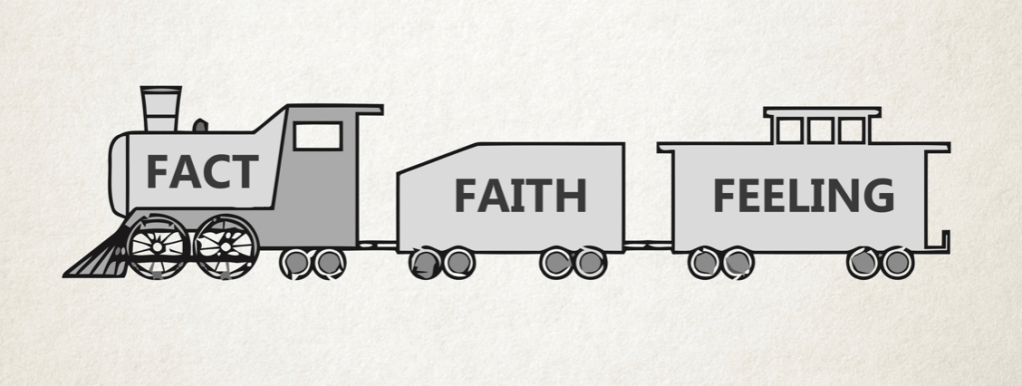
    Then, when I was 13 I discovered this:

    It was in a tract by Agape Ministries in the UK, and my church undertook the ministry of it (and I did as a young leader and keen one) , to do a course on evangelism, that included 5-6 weeks on it, and then use a tract, ‘Knowing God Personally’ – that described the ‘bridge’ and the had this train on the back.

    The premise of the train was that Faith was based on Fact (and not feelings) and that feelings somehow were the carriage that followed on behind. Facts. Knowledge were important.

    Feelings followed.

    Faith was based on fact, because, it was important to know the bible, know the facts, know that it was historical, know that it was true – historically, know so that an argument could be ‘won’ , know so that faith was subject to what was described as the ‘turbulence’ of emotions.

    It also meant that even if I didnt ‘feel’ happy – or ‘feel’ that God was close, that I ‘knew’ that God was and that this provided certainty… apparently.

    As a young person who knew their trains. As a young person that had disconnected from their emotions – this was all great.

    Feelings were just an added bonus extra and not to be regarded at all.

    I could hide having feelings even more. And when I did have any feelings or emotions in life, over the next few years, or more – I could then ‘know’ that these weren’t what God would want me to have – feel shame for having them – and then consider it to be sinful to feel – and then ‘get back to knowing’ . Read the bible, Read, dont feel. Learn.

    If you know, you know – but the ‘Toronto Blessing’ stuff made things interesting for a few years. My ‘knowledge’ orientated church was cautious, compared to more charismatics. People ‘felt’ in the church for the first time, and it made them weird. And I went along to some of the weirdness, and I was determined that I wasn’t going to ‘feel’ the hype. It was the only time that permitted feelings came to church in my time. And it was pretty mad. And for those who for whom it was too mad, they retreated back to the safety of knowledge and facts.

    For me?

    I went on to become a ‘leader’ in churches, and so I had to be ‘responsible’. Therefore showing emotions wasn’t part of it. I had to be mature, I had to know things, I had to lead, inspire and have integrity. I had to cope. I could be professional. I could be ‘adult’. I could leave all and any child behind.

    As someone who had a disconnected sense of self, (and what I learned about ‘self’ spiritually is a whole other post) , church could easily be a place where I could hide emotions, where praise was heaped for stoical behaviour, and the pursuit of knowledge.

    Maybe now I have language for all of this experiences, growing up even in the early 1990’s where there was no conversation about emotions…anywhere, especially not for boys. Adapting into ‘Adult’ life as quickly as I could was what I needed to do, run away from childhood asap, and leave behind what that represented, emotions, play and curiosity. Was feelings free Christianity really what was on offer? Maybe thats not what was intended, but it meant that I could negate that carriage of the train, in regard to my spiritual life.

    I wonder now what the cost is and has been. I wonder how common this is in other denominations around the UK or beyond. I wonder whether emotions in church are ‘just’ for the hysterical or depressed, and how these are to be ‘got rid of’ or ‘discarded’ for being uncomfortable or in some way unspiritual. Im not blaming the church I grew up in for what it didnt know, but I also know that there were many in that church who were as bewildered and scared of the same monster that I had to encounter every day.

    Maybe it all goes back to way before the ‘Fact Train’ , Karen Armstrong writes about how the myth of the sacred story was turned into a desire for objective fact of the Biblical narratives, around 400 years ago. The feeling of the camp fire story making way for the cognitive reading, but this isn’t a general history lesson on theological feelings and emotions, its about how I could leave feelings and emotions at the door of the church, but in reality, I could leave them buried deep down, hidden away, and mask the childhood emotional abuse that happened.

    It has been a long road, a long rail even. It has been one for me in which I have begun to let the feelings and emotions out of the shadows, and be accepted as part of me.

    If you’d like to read more on my Spiritual Journey, or the resources that have helped me to reconnect my emotional life with my spiritual one, do have a look at the resources above. I particularly recommend Eckhart Tolle, and Gary Zukav, though there are others too.