Tag: narcissism

  • Walking the hard road of loving myself

    Walking the hard road of loving myself

    Who is the most important person in your life?

    The hardest thing for me, was too realise..that this was actually me.

    What are the things you look after? Your bike? Your tools? the remote control? The car?

    What about yourself?

    I didnt.

    I had no idea how to.

    Theres a great description in the beginning of the book Matilda by Roald Dahl of the sickening parents who espouse greatness on a mediocre child, compared to the parents who completely ignore, belittle and fail to see the magical talented one. I found it revealing as I re read it a few months ago.

    Growing up, messages I heard were that ‘other parents spoil their children’ or ‘pamper’ them

    or

    ‘We’re not going to put pressure on you by rewarding you with money’

    These and others were projections.

    Justifications for a lack of support, acknowledgement and encouragement – for..it couldn’t look like being spoiled or pampered could it…

    Justifications for expectations, and for emotional neglect.

    The thing is, is that as I grew up looking for something that would never happen, I ended up forgetting myself, and times that I did think I was choosing myself, it was seen as being selfish.

    The thing about the constant walking on eggshells, is that your only trying to avoid them, appease them, sooth them.. what happened to me, and others with narcissistic/emotionally immature parents or partners, is that I lost myself.

    There was the ‘me’ that tried to be compliant

    There was the ‘me’ that realised that they had to do life alone

    There was the ‘me’ that had to discover a way of doing life despite them

    There was the ‘me’ that was only scared.

    There was the me – who was unable to make decisions or choices or have needs and wants – because..

    There was the ‘me’ that effectively was oriented around them…around her….around the other

    I hadn’t ever realised myself as important or valuable. How could I? The key to survival was meet their needs.

    What do you mean ‘I’ might be important?

    that just sounds like being selfish James….

    you have to meet my needs, I cant cope if im not the needy one around here

    Isnt God the most important thing in your life James? not you….

    In a way it was easy to hide myself in a profession, vocation even, where I could think of others before myself. Love my neighbour, and get angry about injustice ‘over there’ – rather than be angry about my own condition. Love myself enough to have something to defend.

    Thats the thing with emotional abuse – you become devalued and fearful into becoming almost nothing, but a slave to them.

    Back to Trauma bonding.

    No wonder I and many others dont just get emotionally abused once. Childhood abuse sets us up again.

    Why?

    Unless its obvious, but even then, we dont know how what abused us did so, and therefore we have no words or language to describe it, or then get help to recover from it. So we blindly give ourselves away again in the same way we only know how to. Attracted to only slightly less worse treatment than we’ve already had once. Or think we can try and fix this new abusive person.

    I started to realise, once I had permission and safety to be able to, that I was important.

    I started to realise that I was valuable.

    I started to realise that I was worth something – not just for what I did..but who I am

    I started to realise that I could love myself

    I started to realise that the I part of me, my -self – was ok, was good.

    How did I realise?

    Because I started to give myself time. Because someone treated me to some food, and a house, and somewhere to stay when I had nothing. Because I received.

    I had no choice.

    I was important enough..to be cared for myself.

    It was only a start, it was all it needed to be, a start to realise – but it was a new start, I became my own new toy.

    I was important enough…to invest in discovering myself, and paying for therapy – internal work a priority – rather than external entertainment…because I am important

    I was important enough…to value my time, my safety, boundaries of noise and distraction

    I was important enough…to say no and block those who caused abuse.

    I was important enough…and somehow other changes took place..

    I was important..so its ok to buy myself new clothes, eat nice food, travel and buy things for me that I like, it didnt need an excuse or reason.

    Maybe these things come naturally to you, but they didnt to me. Buying things for myself had previously been met with ‘do you really need that’ or ‘nice of you to spend money on yourself’ or ‘you already have one of those, why do you need another one’

    Because someone else needs and neediness more important that my own.

    Gaining self importance was one of the big keys for me in unlocking the doors, removing the layers of onion skins of re building and changing that I needed to do. I would say now that I spend 40 odd years of my life having no sense of self worth or value at all. It was hard work, it still is, as it involves new habits, behaviours and patterns that were default for a very long time.

    I had an inner voice that told me repeatedly that I would get through this, I would survive, that I would work it out…but not an inner voice that told me that I was important, that I was worth it… so when that started to change it was a big thing.

    Feeling and accepting a healthy self importance has been the journey I have made from a place of emotionally empty selflessness.

    Who is the most important person in your life?

    You are.

    And that isn’t selfish. Its the truth.

    How might you start today?

    Are you about to pick a fight with yourself over it?

    Give yourself excuses not to bother?

    Make a reason?

    Yes, its fucking hard to do.

    But you are the most important person you could love today.

    And…so am I…

    Time to love, enjoy, and accept ourselves…we are beautiful just the way we are.

  • What if my Monster only Abused Me?

    What if my Monster only Abused Me?

    Maybe I was going to realise this eventually.

    For all that I have described the details of the abuse I suffered.

    What if it was just me.

    What if it was just me, and my family who suffered and experienced the monster. Our Monster.

    Because, its very likely isnt it?

    Thats the game they play – jackal in public – hyde away in private.

    Public persona – just about gets through – unless challenged, unhinged or worked out

    Ensuring that the suffering goes on alone.

    Ensuring that the suffering isn’t believed

    What if it was just me – because thats more than likely – isnt it?

    The Family.

    They can put on ‘literal’ Sunday best behaviour out there – for an hour a Sunday, or 9-5 Monday to Friday.

    Have friends or allies.

    Meanwhile – was I the only one?

    Was is just my family whose lives were wrecked by her?

    I mean – would anyone in their jobs ever see it?

    Would they ever make a complaint?

    Would they diminish it, or be scared of it?

    Would they ever see it – and choose to ignore it?

    Triangulated?

    Whilst the family suffered?

    But thats the thing isnt it

    Men who abuse their wives – play a great round of golf, talk the talk,

    Women who abuse their husbands – playing the kindly one as teacher, vicar or nurse…or a dominant sales person ready to lie for money

    Hiding behind the social norm, that it’s only men who are abusive

    Could be the person in your workplace, and you wouldn’t know it

    Part of their game, hiding parts of their life away

    So, the family know, they’ve felt the scars

    We’ve then done the lifelong work, amateur psychologists trying work the monster out, professional therapy patients in recovery, healing with survivors gift

    Took us, took me, a long time to realise what it was.

    But can they act out a normal living whilst they’ve abused so appallingly? How is that even possible?

    The psychopath at large, choosing victims appropriately. Playing the victim appropriately.

    Darvo games

    Only leaving the obvious trail amongst the unheard, silenced, victims

    But leaving a trail elsewhere, that only the aware can spot.

    So maybe only the family got abused.

    Only the family saw their splintered personality at large

    Only the family felt the cold

    Only the family were stolen from, emotionally, physically and financially

    Maybe it was only just the abused who know the abuser.

    The truth has set us free – whilst they lie to everyone else.

    So maybe it was just me, just us.

    The victims who know and see – who saw and felt

    It really cant just have been me?

    But what if it was – what if its ‘just’ family.

    They couldn’t do that – could they – be so good to get away with it elsewhere?

    Or has that trail waiting to be discovered? Has no one come forward? Too scared or terrified?

    The shame of being a victim, shame of exposing them, silenced into silence.

    What if there are other stories waiting to be told? What if it wasn’t just me?

    I wouldn’t know – until one of them was brave. Until one of them got angry, until one of them took a stand, but what if that story is dead? – unable to speak?

    Its not possible to be just me – it cant be- can it?

    Whats hidden in places, what trail was left behind, what tales behind closed doors never come to the open?

    Theres no shame in being a victim of my monster, in speaking out – talk to us, talk to me – I already know. You are not to blame.

    It cant just have been me – cant just have been family, can it?

    Surely others can see?

    Thank you for reading this piece, if you would like to respond to me, do so via my contact details, if you have stories of your own regarding my monster, then I would love to hear from you. Know that I will listen and it was not your fault.

  • Surviving Psychopathic Parenting (Part 22) The absence of life guidance

    I have just read two books over the Christmas holidays, as I travelled to San Diego to spend my first Christmas with my partner, and now fiancé, Christelle. I knew I would have time on the journeys to read, and maybe time during, also one of the things that Christelle and I do a lot of is read to each other. The books were ‘The Seat of the Soul’ by Gary Zukav, and ‘The Choice’ by Edith Eger, and today I have just finished the second the two. Both books have been incredible in very different ways. But its Edith Egers that I have underlined more furiously, and brought so many aspects of my own journey to there surface.

    In ‘The Choice’ Edith describes her experiences growing up in Hungary/Czechoslavakia, being sent to Auschwitz in 1938, dancing for the Dr of Death, surviving, when 1m others didnt, being taken to camp, work house, woods, being starved, punished and separated from her family, some of which she had no knowledge of whether they were alive.

    In the second half of the book she describes her marriage, her children and then her journey into becoming a therapist, and then going back to the places, Germany and Poland, where she experienced her traumas. She intertwines beautifully how her patients in therapy brought her to her own self reflection of her past, present and future, and how, ultimately, we all have a choice.

    I will more than likely write about a number of aspects from the book, there are so many. The first is what struck me, about the things that gave her hope during the years in Auschwitz; three things emerge from her story; One is the love of her life – Eric, who she was separated from, the other was her Sister – who she was with for much of these years – and the third thing were the words of her mother – and the dream that one day she would see her mother again.

    ‘I hear my mothers words come back to me, as though she is there in there barren room, whispering through the music..‘just remember, no one can take away from you what you have put in your own mind’

    Later Edith reverses something her mother had said to her (Im glad you have brains, because you have no looks) in Auschwitz, for survival, she translated this as ‘I’ve got brains, I’m smart, I can figure this out’

    One of the questions my therapist asked me in a very first session with her over a year ago was ; ‘What were some of the life lessons you received from your parents?’

    Nothing.

    But that wasn’t exactly true. There were rules… but not life lessons

    Whats fascinating is that the very people who want to control you, dehumanise you, abuse you and neglect you, are the very people who give you no advice for how to overcome them. That makes sense, doesnt it.

    So, had I been sent to the plains of the Gulf in 1990, or Kosovo in 1997, or a Nuclear bomb landed on Market Harborough in 1991 and I was having to survive that situation, there would have been no life advice, at all. I would have been armed with such wise sayings like

    ‘Dont you dare upset me again‘ or

    I need you to make me proud

    Dont you be so smart’

    You’re asking too much, dont be spoiled’

    I needed to get that temper out of you’

    Dont be so ungrateful’

    These would have been pretty useless in terms of what I needed to survive, should I have been put in a place to have to.

    Thats the thing, they dont give you guidance for life – just rules, or invisible rules, of obedience in their created world. Its like any of the ‘gifts’ they give – they are loaded with hidden meaning, and rarely meant for your actual good.

    Unlike Edith, I had to rely on an inner voice despite the emotional contagion of the parent who’s world everything had to revolve around. How do you trust an inner voice that is so disabled and frightened?

    I also realise, that from a very early age, probably 9-10 that I had to rely on myself, to survive – developing my own inner voice that was all about survival. Not unlike Edith, but my escape date was when I was 18, and I was counting down the days from about the age of 12. Edith had no idea when hers was.

    My personal prison, was the family home – with the emotionally abusive monster within. I don’t compare my situation to Ediths in terms of severity in any way, but it brought to my attention the lack of guidance or wisdom passed on to me by my parents, ever. I also note how desperate Edith was to see her parents again, to have them alive, to go back to a time when this was the case. I watched as other children ran to hug their mum at school and nursery. I had to be dragged away from school, and the one who wanted to be last to leave every day.

    So I developed an inner voice- a survival voice one day this will be over, ill survive, I always do, and needed voices of support from outside the situation. Some from books, some from teachers, some from youth workers and church.

    But its strange that reading a book about a Holocaust survivor brings me closer to aspects of my own past. Closer to aspects that were different for me, closer to aspects that reveal what I did or didn’t have. What if its not your care-giver that gives you couple through the trauma – but the one who creates the trauma? What if thats what I have to heal from?

  • Facing up to the Male Crisis

    Facing up to the Male Crisis

    I have been reading ‘The Courage of Hopelessness’ by Slavoj Zizek (2017) , its a hard read but an interesting one. He tackles some interesting subjects , ranging from Brexit, The EU and in his last two chapters the responses to the US presidential election win of Donald Trump in 2016.

    In this chapter he write the following:

    Men are gradually turning into perpetual adolescents, with no clear passage of initiation enacting their entry into maturity (military service, acquiring a profession, even education) . No wonder then, that in order to supplant this lack, post-paternal gangs proliferate, providing ersatz-initiation and social identity.‘ (Zizek, 2017)

    The section makes some fascinating observations on the nature of the figure Women adopt with in the capitalist ideal. However, it is the ‘Men as perpetual adolescents’ comment that I thought it fascinating to reflect on. Trump, being that archetypal perpetual adolescent.

    Perpetual adolescent’ is an interesting phrase? What might that mean to you?

    What characteristics might this be in reference to?

    Someone with no self-awareness, taking no responsibility, quick to blame others, ‘spitting their dummy out’ , too much ego?, having little empathy, black/white thinking, not great at planning, impulsive, reactionary, rebellious non conformity, school yard bullying, getting what they want?

    I’m reminded of this quote in a guardian article referring to the current prime minister ‘Remember what a teacher at Eton wrote to his father in 1982: “Boris sometimes seems affronted when criticised for what amounts to a gross failure of responsibility … I think he honestly believes that it is churlish of us not to regard him as an exception, one who should be free of the network of obligation which binds everyone else.” A justified retort, of course, would be that this is the exact mindset that Eton is designed to produce – but even in that context, Johnson seemed to be in a league of his own.’ (https://www.theguardian.com/commentisfree/2021/dec/12/boris-johnson-crisis-contempt-covid-levelling-up?CMP=Share_AndroidApp_Other)

    I might challenge Zizek on the point that not all adolescents are like this – many matured to quick, and many young people take lots of responsibility on, and challenge authority, make positive decisions etc etc… but the point is well made, I think..

    In his book ‘Surrounded by Psychopaths’ Erikson suggests that CEO, Media and Sales are 3 of the top 4 professions where a psychopath might work – these are all roles created by capitalism, as Ronson describes in this fascinating and humorous TED talk. A psychopath is someone who shows no remorse, blaming others. Narcissists, closely related to psychopaths thrive in bewildering black/white, right/wrong dualistic thinking. Frederik Riberson describes this well in his videos here – are some of these consistent characteristics with ‘perpetual adolescent’ type thinking?

    Maybe I’m making a few quantum leaps here, but is there more and more a Man crisis? – and does western capitalist society cause/create the environment where this is in even more evidence? Especially to be ‘successful’ within it – is to reject humane qualities – emotional intelligence, warmth, genuineness, complex thinking, empathy?

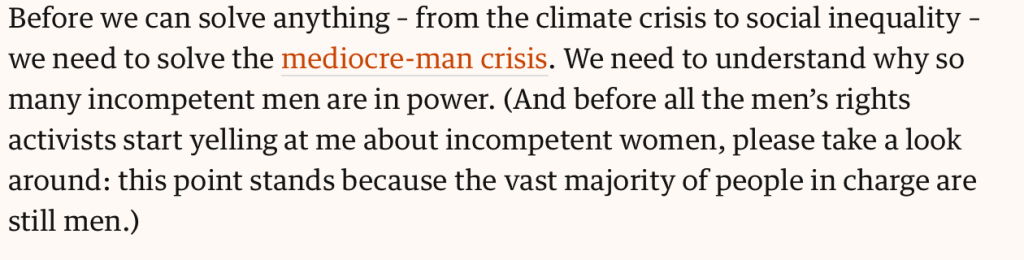
    A piece in the Guardian this week said the following, in relation to male and female leaders:

    https://www.theguardian.com/commentisfree/2021/nov/30/it-is-crunch-time-for-humanity-we-need-everyone-to-start-leading-like-a-woman?CMP=Share_iOSApp_Other&fbclid=IwAR1ZrXub5LsOdN74eyynbjwtfKDslA6x15OEjLYRiiSCaX1g3LPpm8TpAzQ

    Is this about mediocre men Bullying their way to the top? – The BJ’s of this world? The piece also encourages a different type of leadership, a feminine one. (and thank you Jenni Osborne for highlighting the article)

    Is Mediocre man, the same as Adolescent Man? – probably.

    What do you think? Is there a Man crisis?

    There is a different man crisis – and that’s the considerable reality of suicide being the biggest killer of Men aged between 30-50 in the UK. That is most definitely a crisis. Might one crisis lead to the other?

    Men – too given to their persona to not seek help

    Men – feeling shame or afraid

    Going it alone, and frightened to be called out – status to be kept – over kindness for themselves and others

    Don’t be weak, don’t fail, must keep going, must make more money, strength is about winning at all costs….

    and I get it, as a 43 year old male, I truly do.

    In a book on Farming, and farmers have suffered significantly because of capitalism and resultant suicide, James Rebanks offers this, on the state of the environment, and also the human soul. For me it offers something in the remaking of the male.

    Someone who knows the land our very food grows on, might just know something… i challenge you to reflect on this:

    ‘What will our descendants say of us, years from now? How will we be judged? Will they stand in the dust of a scorched and hostile world, surrounded by the ruins of all the exists today, and think that we , who could have saved the earth, were thoughtless vandals, too selfish or too stupid to turn back? will the future know us as the generation who pushed things too far, on whose watch the world began to fall apart, who had so little courage and wisdom that we turned away from our responsibilities ?

    Or

    Will they lie in the cool green light of the oak trees that we planted and be proud of us, the generation that pulled things back from the abyss, the generation that was brave enough to face up to its own flaws, big enough to overlook our differences and work together, and wise enough to see that life was more than shop-bought things, a generation that rose above itself to build a better and more just world.

    This is our choice

    We are at a fork in the road

    There are a million reasons to believe that we are not big enough, brave enough or wise enough to do anything so grand and idealistic to stop the damage we are doing. We are choking to death on our own freedoms. The world of human beings is often ugly, selfish and mean, and we are easily misled and divided. And yet, despite everything, I believe we, you and I, each in our own ways, can do things that are necessary’ (James Rebanks, 2020, p266-267)

    and as Zizek puts it:

    The way to confront anxiety is to look at ourselves

    Zizek, 2017, p281

    Often its desperation, despair and the dive to the depth that causes the change to occur. Midlife awakening, crisis or breakdown – call it what you want to. Transformations do and can happen from within, and happen when there’s no choice but too. Only we, men can change. What do you think – is there a Mediocre Men crisis? And what questions might we want to ask ourselves, as men, deeply to be courageous, face our flaws and be brave to do the responsible thing?

    Its time to face, fully the prevailing male crisis, and it starts with each of us, and it continues with our own boys.

  • Boys and their Abused Dads

    Boys and their Abused Dads

    As a youth worker you get to hear alot of stories and moral panics about abusive or absent Dads, and the effect this has on children. It is often in regard to the behaviour of those children, especially in education or criminal contexts. Theres a cry for ‘better role models‘ – assuming that parental role models aren’t good enough. It is easy to blame the parents.

    The same rhetoric was used in those ‘christian’ mid nineties evangelical circles too that I grew up in, anyone else remember the ‘Even if your Dad was ______, God is a perfect father’ type stuff. Usually the reference to a Dad being abusive or absent. Strange thing then, that during those times there was little critique on that ‘perfect’ father sending a son to die.

    I digress, and the discussion on absent or abusive fathers doesn’t really need repeating here, only to note how pejorative it is, and only too often, sadly and tragically, how common this is, and with the misuse of concepts like ACES*, children and young people are predicted behaviour and outcomes based on this in state settings, and barely given a chance to be different at times.

    But my experience is different. And so might yours be.

    What about a boy raised by an abused Dad?

    Ive just tried googling images for ‘Abused Dad’ – have a guess at what I found?

    This:

    Note what emerges.

    Article and article about Abusive Dads and Fathers. men who abuse their wives, their children, who dominate, hit, provoke, sexually abuse, financially abuse and the list terrifyingly goes on…..

    Not Dads who are abused themselves.

    I watched this a few weeks ago

    In the TED talk above, Justin reflects on the qualities of his Dad, and how growing up he was determined to be different – Justin didnt want to be soft, kind and gentle – only to realise later that these were good qualities to have, and were part of his core.

    So I pose myself the question; What kind of a Man did I learn from my own Dad?

    Let’s start with the positives – everyone, outside, and some inside the family love my Dad. He would do anything for anyone, mostly in a practical way – fixing, decorating, making, constructing, he is softly spoken and rarely impulsive. He worked hard, and didnt cause or create any stress or drama.

    But the rest of the time, he was a ghost. He was belittled and devalued, and threatened, walking on eggshells all the time. He could only obey the other parent, becoming the flying monkey, the accomplice, completely untrustworthy. He tolerated being lied to, by someone who was gaslighting him all the time. I dont remember him ever expressing his needs, ideas or dreams, and was told what to do nearly all the time. His invisibility extended to offering almost no nurturing or protection at all – deferring everything to the other parent, someone so sunk that they couldn’t be a healthy father figure at all. One who conceded.

    I could go on, as there is more, and none of this is to be critical of him – given the extent of the manipulation he has suffered – this is more to reflect on what its like being Male, and a Dad, and growing up with an Abused Dad.

    For one, there is almost nothing to read on this – even some of the emotionally ‘immature’ parent books defer to general characteristics of dominating Dad figures – and as I said above – try doing a google search.

    Boys or Girls and their Abusive Mother figure may come up, but what are the effect on a child of their abused Dad?

    What kind of Man/Masculinity did I see, and experience growing up?

    Someone passive to women or others needs – no regard of their own

    Someone with no role with their children

    Someone with no voice

    Someone weak

    Someone who accepted being lied and pretended to

    Someone who is weaponised by the other

    Just a tool for someone else to get what they want.

    I reflect on these, not with anger or bitterness, not with remorse or grief, but a sense of being in the process of understanding what the effect of an abused male care-giver had on my life – and not just an abusive female role-care giver. The abused dad rarely gets talked about, hen-pecked might be a mild term for emotionally manipulated.

    I think what i’m trying to come to terms with is how challenging it is to try and talk about this, ‘some dads are abused too’ ..’some men are abused in domestic abuse relationships’ ‘some boys have emotionally abused fathers too’ – and what’s likely is that these situations are so likely to go under the radar. As that boy, might be kind, sensitive and attuned to the needs of others – and not themselves, that boy might be more likely bullied than a bully, that boy might like the quiet life, that boy might have issues with women – or find themselves in relationships with dominating women, that boy might struggle in a number of ways, but those ways might not be as evident as they dont fit the stereotype, if stereotypes are there to be fitted into anyway. They’re unlikely to be loud in a crowd and make a scene – getting attention.

    That boy, might also struggle to know ‘how to be a man’ ….

    When the female parent once told me to ‘stand up for myself’ it was ironic in that that was something she wouldn’t allow to happen to her, by my Dad. Stand up against bullies…but not the one in the home… a man is never right, a man always gives way, a man doesn’t have an opinion… oh and I knew I would have been punished had I hit that boy back….

    I heard the advice as a teenager; ‘At least you’ll know how to treat a woman, given the way your Dad is‘ or words to that effect, and from a trusted source I internalised this, probably too much – to the detriment of treating myself, and being passive, putting myself lowest emotionally on the pecking order, because as I reflect I wonder how much that person saw and knew, and with the benefit of hindsight, the behaviour that has occurred 30 odd years since.

    I reflect on also on the question of how all these things, and more, might be similar to children who grow up with the experience of their mum being emotionally, physically, sexually or spiritually abused, and what that is like for them, and whilst I clock it here as being highly significant and impactful in their life. This isn’t , as I say my experience, but I want to note it – and whilst its significantly more common, it doesn’t make it any less damaging on the child – this is in no way a comparison piece, but something I wanted to recognise.

    There are plenty of cold maternal figures in the world, and plenty of female narcissists/psychopaths that go under the radar, yet alot rise in politics, business and also the church, and yet their damage to the men in relationships (and other females in their friendships) as well as their children is being more and more well known. What we don’t want to talk about is that Mothers have are cold, colder than ice, with only pretence of warmth, if that. So what might that mean for the Male parent, and how being the victim of domestic abuse , has on they children they have? – especially for their boys? What about the children, the boys, who get caught up the female narcissists loyalty games against that abused Dad? What kind of male/masculinity does that boy grow up with? What kind of insecurities might they have to deal with? What did I? The list is extensive – alot of written about already in my story above.

    For the Boys growing up with Abused Dads – what is that like for you? What resources have you found to be helpful in this? Have you found some good articles on this – please do share them below, it would be great to have comments and conversation on this, if you want to get in touch and share a story or piece on this, do let me know.

    And, to finish with that theological premise at the beginning, I can’t help but wonder what kind of God I internalised given the association that was made between earth and heaven Father figures.

    Maybe this is a conversation we need to have – whats it like growing up with an abused Dad?

    *ACES – Adverse Childhood Experiences

    Thank you for reading this piece, if you would like to support me financially as I share, write and develop conversations that are Healing for Men, you can do so here, all gifts and donations appreciated Healing for Men

  • 15 phrases not to say to children of abusive parents

    A few months ago I wrote a piece about the myths that surround in regard to parents – myths like ‘Parents love you whatever’ or ‘Mums are so supportive’ that do nothing for anyone who’s experience of parents is vastly different to this, to the point of being abusive, physically, emotional, sexually or spiritually (or a combination of all of these), they do more than nothing, they give these parents an already sympathetic starting point. If you want to have a read of that piece, it is here ; The myths about parents that prevent abuse from being believed.

    You see the thing is, when youve known that your parents have been awful from an early age, you get the opportunity to respond to alot of ‘well-meaning’, sometimes trite, sometimes misadvised comments from people, who might be trying to help, without actually knowing the situation.

    Sometimes these phrases do no more than pile on heaps of guilt and shame – that somehow I was to blame about the way my parents are, or were towards me, or they sort of encourage a kind of grief/guilt – that somehow I ‘should’ feel this way about my parents…but I don’t.

    Maybe these are things ‘not’ to say to a child who is known to have difficult parents. Maybe these are things not to say to an adult child who is now able to deal with those parents, or even to grandchildren who have worked out their grandparents. Most of them I have heard in one form or another.

    1. They can’t be that bad…because you turned out ok
    2. They could have been worse
    3. Your Poor parents having to deal with you
    4. At least they stayed together when other couples didnt
    5. You only get one set of parents
    6. You’ll miss them when they’re gone, trust me
    7. At least you have 1 decent parent
    8. Of course they’re not perfect, you have too high expectations – go easy on them
    9. Considering their past, they did their best
    10. Look at what they did for you, kept you fed, and watered
    11. You’re meant to honour them, the Bible says so.
    12. You have to learn to forgive them
    13. One day you’ll realise they were right all along (isnt that what they say about Dads?)
    14. You’ll grow up and accept them as you get older.
    15. Is it fair for your children to miss out on their grandparents?

    Can you see how harmful some of these comments are? Ive received nearly all of them over the course of the 43 years of responding and trying to deal with my parents.

    Some of these reflect how the person has been manipulated by the parents already (3), some of them reflect how that person might feel about their parents (6) others reflect a moral/spiritual imperative (11,12) that then requires some unpacking to not take on that shame and guilt.

    Some of them seem to want to blame the child – that somehow they are responsible for their parents (8)

    And some reflect that being grateful means that parents fulfilled a legal requirement , to be fed, watered and have somewhere to sleep (2, 10)

    And obviously, the way I grew up and became who I am has something to do with them. (1) Gees, thanks for that one, they stole enough without that credit. What if children raised by narcissist parents got somewhere..despite them? not because of them. Yeah. Exactly. Because that’s the only way, or its a pile of self destruction and torment, or both.

    It could be easy to say 9. But then again, thats like saying that every action they took for an entire parenthood can be attributed to their own childhood. And not everyone who grew up a baby boomer, or had a difficult childhood, or even an entitled one, is necessarily a bad parent. Some do the work. Some take responsibility.

    For 7, see here.

    And for number 5. Yes, you’re right… but your point is?

    and 15… difficult one, but protecting them from harm is more important than toxicity and gifts.. isnt it?

    Lets deal with number 6. Are you sure about that? Actually really sure? – didnt think so…

    So maybe, if you have good parents, maybe if you’ve got amazing parents, maybe if your parent is your best friend, then do have a think about the effect of the well meaning saying on someone who really doesn’t have that kind of relationship with a parent. Someone, who maybe has had to do alot of work to create their own safe distance from their parents. Someone who has had to undergo the emotional torment of parent stuff for a very long time.

    And that leads me on to number 14. This one is the only possible true one. Because growing up does happen, seeing them, even clearer does happen, accepting them does happen too, as does accepting that they are unlikely to change, they get worse (as Nina Brown describes) , and accepting and spending time with them are two vastly different things.

    So from someone who has struggled alot with their parents, and heard many if not all of these things and more about what I’m expected to do, or feel about my parents, i thought I would write a few of these sayings down, because they are so common, so often said, and just want to say that you dont have to accept your parents, or like them, or put yourself in a place where they do not respect you. You are valuable, and can create situations to protect yourself from them.

    And, sometimes its about biting your tongue, or giving that look to anyone who gives you the gift of the well meaning, but harmful phrase like above.

    This piece was inspired by this one from Peg Streep ; 8 things not to say from someone estranged from a parent in it she writes the following about children who have to protect themselves from their parents, effectively estranging them and blocking them. I like what she says in response to my number 11 :

    The taboo has the back-up of a Biblical Commandment which enjoins us to honor our mothers and fathers as well as deeply-held ideas about filial obligation and the never-ending gratitude we are supposed to feel for those who put us on the planet or took us in; who fed, clothed, sheltered, and educated us; and paid for all of those things. Since those happen to be legal requirements, it’s actually not snarky to note that if that were all that is required of a parent, an orphanage would be an ideal one.

    Even though recent psychological research substantiates that the decision by the adult child to estrange from family is long thought-out and a process that may include periods of attempted reconciliation by the adult child, the culture still frames it as a fit of pique or anger and a sign of immaturity. In researching my books—over a decade now—I have found the decision to estrange as is almost always deeply thought through, worried about, and revisited in the thousands of people I have heard from over the years; these stories echo my own.

    If you want to read more on this subject then I do recommend the books in the self-help resources section of this site, especially Nina Brown and Lindsay Gibsons, and also, in the process of seeing, realising, and loving yourself through the challenges of emotionally abusive parents, do seek out professional therapy to help you to reconstruct, and rebuild through it.

    Feel free to share and like this piece to help others. Thank you

  • ‘Why cant I just have fun?’

    ‘Why cant I just have fun?’

    It sometimes feels an effort to have fun – dont you think? well it does for me

    Nothing is stopping me, I can do what I want, So what cant I?

    But then I started to realise why… its those voices in my head, the critical ones, the sensible ones…these ones…

    ‘Are you boys having fun?’

    Came the voice of the abuser to me, on a number of times, its often at a time when I have actually been having fun.

    Its tone was accusatory. It was as if ‘fun’ was not allowed.

    Fun was ‘found out’ – look you couldn’t hide it from me, you were having fun

    Secret fun.

    You doing have fun without me, you don’t have fun in this house,

    Isnt there something more useful you should be doing… like meeting my needs instead?

    Fun guilt.

    Just dont make a mess’

    Fun now has to be clean, organised, tidy.

    ‘I didnt say dont have fun, just keep the noise down’

    I gave up fun, fun was no fun..

    Another factor in the fun thing for me is the church thing.

    Growing up evangelical – meant having conditional fun, and being judgemental on other peoples fun

    ‘Look at us having fun without alcohol’ – at a barn dance that is excruciatingly painful in 1991 with other ‘young people’ who are finding it excruciatingly painful watching their parents dance and look as though they are pretending to be having fun and its just so awful. Then to be forced to dance. URGH.

    It wasnt just sex, drugs and rock and roll that were banned – it was anything that was the gateway to any of these things, school discos, pop music, smoking (anything) ..- we dont do what they do

    Fun for me as a teenager was doing ‘christian fun’ – what was allowed – the christian music festival – and yet even there I struggled to have fun, because I was so un easy about having fun, with the exception of sports, just dont get me to dance, or draw

    Problem is in a context of what is and what isnt allowed….nothing seems much fun

    If Fun is about doing something for the sake of it, doing something that might be boundless, free, creative and spontaneous.. then I realise that part of rediscovering myself, and my inner child is about ‘having fun’ again

    I can definitely see how having conditions on fun – meant that something wasnt fun

    I can see now also that as part of the trauma of growing up with a psychopathic parent, that fun wasnt part of the deal, because more than not fun was about being responsible, staying alert. The only fun was to do the thing they wanted to do.

    Theres only allowed fun in abusive narcissist prison.

    Guilty for having fun? Shame for having the wrong kind of fun? Too responsible to have fun?

    Too inhibited to get drunk, always needing to be aware, responsible and look after others..- yes

    So when did I start to notice this, and realise it?

    I notice all the time, id rather be serious, think about serious things, learn, write (like this), digest the news (see previous post), and even some hobbies can feel like a performance, competitive…

    I really noticed about fun when I asked my inner child what he wanted to do that was fun – and then actually do it

    It was my inner child that wrote what it above.

    I noticed too when it felt a momentous action to pick up a felt tip pen and make a messy splurge on a piece of paper.

    Dont make a mess, stick to the lines, you cant draw, dont be silly, that’s silly…voices in my head, every time

    Be a grown up, dont be childish, whats the point, haven’t you something more responsible, or helpful to do – like write a blog or check twitter or tidy, or…

    I realise that its a struggle to ‘have fun’ – when the voices in my head, the critical parent – from the sources of those critical voices, abusive people and excessively moral churches – have been so dominant, and Ive been conditioned to comply, to fit, and found belonging or a trauma bond in compliance.

    Overthinking fun makes it a struggle to have fun at all.

    Just need to do it.

    So one of those things is that fun is guided.

    What do I do now for fun? new things that ive never been interested in before… and also new things I didnt know I could do before, as well as some of the old things like trains, cycling and growing food, but also photography,

    Walks, and after those occasions a few months ago, now experimenting with drawing, art and self discovery in drawing, colours, and art – something I left behind as a child. Learning to be creative will be another piece, but at this stage, just to say that ive discovered something fun in stuff that I thought I couldn’t do or hated as a child. Its like an unlocking.

    PICK UP THE PENS JAMES. JUST DO IT..so..

    Heres something I drew yesterday, just for fun….and with both hands simultaneously…

    Safety is so important in the pursuit of creativity – unless you dont give a fuck about what it is you’re creating and potentially upsetting in the process

    So often emotional abuse resolves around the shameful control of behaviour and that includes ‘what is allowed as fun’

    Often those who cannot have fun project rules onto those so it prevents them from doing so.

    I do find it a struggle to have fun.

    Maybe thats an ‘adult thing’ – but I’m more sure its a recovery from narcissistic abuse thing too. Life was about survival – and fun doesnt play a part – (maybe except outside the prison walls)

    A few thoughts on Fun:

    I can relate. When you’ve been fighting for justice or for survival all your life, it doesn’t take much to be content. A safe place to live, some peace and quiet, can be enough for a while. Your idea of fun might just change a bit. (Ryan on Twitter @Ryan_Daigler)

    I think I feel guilty for enjoying myself? And also sometimes in the past bad things have happened to others whilst I’ve been out enjoying myself so there’s that.(Lydia @Lydimoo)

    and someone trying to..

    I promised myself I would do fun things while I’ve got all my evenings to myself during the school holidays. It’s not yet working out as planned, Ive killed alot of time playing games though (Helen @Helenmt)

  • Abusive Mothers: Some Children do ‘ave them

    (More than as as society we would want to admit)

    Culturally we have a problem with admitting and accepting that birth mothers are abusive. Its bad enough trying to go against the myth that they couldn’t be loving, kind and supportive.

    Abusive fathers feature in films, books and TV series. I noted one the other day, the hero/sporty trope as Troys dad in High School Musical, there are many others. (watch it again, not just for the music)

    Abusive Step Mothers appear onto the scene to wreck the idyllic lives of Disney characters – see Cinderella for one.

    Children have to overcome the loss of their real parents, (Cinderella again), and also Harry Potter, and these are replaced by abusive guardians. I couldn’t call them care givers, they dont care., at least not about anyone but themselves.

    When Mothers are seen to be abusive, theres often a mitigating factor, Dad is also abusive, they are alcoholic, they had their own issues, both current, and historic.

    Its as if there has to be a reason that a person, a mother especially, would not be caring, supportive etc.

    On Twitter Laura Corbeth shared this the other day, it struck a chord. Its as if we’re still not ready for the conversation.

    Its even as if there is mounting evidence of narcissistic, sociopathic, bullying women in society, in politics for one, but the thought that even these bullies in the workplace would be different for their kids…

    Some of those myths I wrote about in this post.

    Abusive Mothers exist. Some Children do ‘ave them.

    So, whilst I compare notes of the children’s fiction stories I have read in the last few months there has been one key difference. There is no doubt to me that Harry Potters development is about overcoming trauma, of the death of his parents, and also the physical, emotional and neglectful abuse of his appointed guardians.

    Roald Dahl is brave, and in his fictional story ‘ Matilda’ he casts the main character as the survivor and flourisher within a myriad of toxic relationships. The Driven, Crooked, Dad , the blonde, passive, materialistic mother who plays pacifier, but not protector. There is also the abusive Headmistress who Dahl gives away the strategy for all bullying behaviour. Do it so that it is so shocking. Anyway, back to the parents. They are her Parents.

    What they do is split up the children. There is only two of them.

    The other brother is mediocre but the favourite, high expectations.

    Matilda, is younger sister, has hidden talent, is highly clever, and realises that she has to make it through life alone, with no support, encouragement, resources – and on the back end of criticism, neglect, and no emotional support whatsoever ever.

    It may be said that the Dad is the stronger of the abusers in the story, but what it does show is that the nurturing supportive mother is utterly lacking. As I said above, the reasons for this may well be that Matildas mother is in the shadows of the domineering narcissistic entitled father. But theres no attempt that Matildas Mother does little other than reveal the depravity of her father to Matilda.

    In this good reads list, Matilda appears as one of few books in which Abusive Parents are described.

    In this piece, the author describes the signs that you have an abusive mother.

    They include:

    • Constant criticism
    • Eratic responses
    • Shame and guilt to manipulate
    • Being blamed for her situation
    • The silent treatment
    • Its your job to keep her happy (or ‘the peace’)
    • Nothing you do is good enough for her
    • You had to earn things you received (or had to beg, because it was what was needed only)
    • No Privacy
    • Speaks in an aggressive or belittling way.
    • Wont allow you to be yourself

    Theres alot more in the article. Theres more that I would add to this and ive written about them in my survivor story.

    Its difficult to comprehend if your parents are half decent (none are perfect) , at least some element of maternal, supportive, nurturing. Maybe Its because Its seems so out of the ordinary that it becomes difficult to comprehend.

    I remember watching other children in nursery running to their mums as they came to collect them. So that means I didnt. I knew. As Ive written before I did just know, but as a child there was no way out, and no way of being able to describe it.

    Gaslighting

    Walking on Eggshells

    Toggling between abuser and victim like a light switch

    Having no empathy

    Taking no responsibility for the nature of the relationship

    Blaming others.

    Being accused of things that are so untrue – Matilda the great reader of books resented being told she was ignorant and stupid, when she was actually a genius.

    Sometimes, for me, I wonder if it would have been easier to turn up at school hiding bruises. The one off hit. The physical obvious mark. Emotional abuse is far more difficult to articulate. Especially when the perpetrators of it are good at invalidating the victim first. Matilda’s Dad had already sounded out to the abusive headteacher. They triangulate to force the victim into silence, and instils fear and division so that you get to feel utterly alone, and bewildered. Im not sure which books read to enable her to see the patterns, or whether she just responded to the abuse each time. But it can take years to articulate, even if everyone knew. And Im not negating anyone who is physically abused, not in the slightest.

    If this has been your struggle, then theres resources above to help you identify, if you know of a child who is in this situation, then this list of books may help them to become more self aware emotionally in the midst of a damaging situation. It will all help.

    The problem of abusive parents is something we have to take seriously, and spot the signs in the child.

    Its a reality we just doing want to believe. But for the sake of so many children, and now grown up adults. We must.

  • Recovering and Healing (Part 2); The book that saved my life

    Recovering and Healing (Part 2); The book that saved my life

    Ask yourself the question; ‘What book saved your life’?

    If you are in anyway spiritual, then it might be likely that a sacred text, the Bible or the Ko’ran might be the book that went some way to saving your life.

    But aside from a sacred text – can you name a book that , honestly, saved your life?

    Not just a good book, an inspiring book, a book that you’d take on a desert island.. but a book that saved your life? That had that much impact on you, that it literally saved you. Some of the stuff Matt Haig writes has had a profound impact, as has the cartoons of Charlie Mackay – but could you name a book that saved your life?

    I could.

    It was the first book I read as I started to heal. It was this one

    to buy it a link is here

    From the very first page, this book spoke in a language that I hadn’t heard before.

    It told me about me.

    It told me about what I had tried to cope with all my life.

    It meant that I wasnt alone.

    Nina makes these assumptions about the reader, writing on page 3:

    You are an adult child who has one or more self-absorbed parents

    You can feel ineffective much of the time in interactions with your parents

    You have been given the responsibility for your parents psychological and emotional well being and, either now or in the future, are expected to assume responsibility for your parents physical well-being

    You never feel that you have accomplished enough for your parent; what you do never seems to be good enough

    You experience numerous difficult situations and interactions with your self absorbed parent

    You are searching for ways to minimalist how your parents distressing behaviours and attitudes affect you

    You want to intervene to protect those nearest to you, such as your children, from the negative and distressing comments, put downs, criticism and the like that your parent continues to make

    Nina Brown, 2015

    Now, im not saying that each and every one of these was applicable when I read this book over 2 years ago. Without giving anything away, some very significant things have happened to enable these things to have happened in the last year (which makes looking at this list now, quite remarkable)

    But… over 2 years ago, this book saved my life.

    It is undoubtedly, direct a book, with an amazing title, one I needed to hear.

    It showed me that there were reasons why I reacted in the way I did.

    I read it at a time to try and understand why I struggled with conflict. What I discovered was a whole lot more.

    It showed me that how ever hard I had tried, it didnt matter.

    It enabled me to see myself. It also helped me to assess how I had been treated.

    And that it wasnt my fault.

    The book has exercises (rate your parents self-absorbed nature), and gives different types of self absorption, as well as then describing the principle ways of responding (fight/flight/freeze) and offering alternatives.

    In way some of those details did and didnt matter.

    I think though the reason that this book saved me, what what it meant, for me. It meant that I wasnt alone.

    It meant that I could be healed

    It meant that I didnt have to carry a burden I had unnecessarily carried

    It meant that a journey of healing had began.

    Maybe the book that saved your life might be a different one. It’s likely to be. Maybe the first self-awareness book you read in the recovery from abuse might evoke the same feelings for you. Not only do I thank the book for what it did, but also thank the person who saw my situation and recognised the patterns and traits, and gave me the book to read.

    ‘Children of the ageing self absorbed’ by Nina Brown – The book that saved my life.

  • Is Generation X  healing from Baby Boomer Parents?

    Is Generation X healing from Baby Boomer Parents?

    (This blog is written by James and Christelle to accompany their latest video which is here, in which we ask the same question. We would like to prompt a conversation about this, and would like to hear from you and invite you into the conversation.) 

    This blog is dedicated to those who have supported us on our journey.

    It is also for those whose hidden journeys are yet to be revealed.

    Why?

    Because we are wondering if there is a trend going on.

    James; When I was first volunteering in Youth Ministry back in the 1990’s, there were a number of studies done about the difference in ‘generations’.  The reason was that youth ministry then, and now, became about relevance. Discovering what each generational demographic was broadly like, became a guide, and marker. What we didn’t really hear about was stuff about the potential of generational trauma to be passed down from one generation to the next. Why do I say this?

    Well..because…

    It seems like there are a significant number of people in their mid/late 30s through to 50’s (Generation x born 1965-1980) who are undergoing a realisation of the emotional abuse/trauma from the parents who were born around 1945-1960 (the baby boomers)?

    Why might that be?

    We’re not sure that Generation X has hit ‘mid-life’ crises all at once.

    ‘Mid-life crisis’ ….doesn’t equate to the number of people who are having their eyes open to the realisation of the horror of the behaviour they were subjected to as children or adults, by their Baby boomer parents.

    Descriptors like entitled, precious, favourite princess babies (after the war), narcissist, self obsessed, driven, also.. busy, aloof… are all words that fit the behaviour of many parents from the Baby Boomer generation.

    Psychologists and counsellors have also said the same, in the following books.

    Maybe its now when Generation X have had enough, and started to make different decisions, rather than accommodate abuse.

    Instead its time to deal with it, by working on themselves.

    Realising that they werent the problem all along.

    Maybe, as in our own case, we realised that we played rescuer, and it was a role that was exhausting.  It’s time to devolve that responsibility to those who should have it themselves. It’s easy to be forced into the rescue game for those who play victim and persecutor. Its ironic also, that generation X will continue to over stretch taking responsibility for an older generation as they age.

    What caused it?

    We could go further back and make an argument that the parents of Baby Boomers could be ‘at fault’ – but this isn’t about blame. Blaming upwards, or not taking responsibility, is what we’ve heard all our lives.

    We are already the generation who has taken responsibility – by fighting on climate change, poverty, young people, equality and many other matters, we are already equipped with knowing that if it’s going to change, only we can change it. We’re also seeing our children fight for justice at an earlier age again.

    Blame won’t change the pattern. We already know change starts with us.

    But we’re wondering – is there some kind of collective generational trauma revealing and healing going on?

    So, are Generation X adults undergoing a collective healing from Baby Boomer parents? 

    Open question..What are your thoughts?

    Please comment below, please do share this post or our video. Maybe talking about it might mean that you can know you’re not alone.

    If you would like to watch the accompanying video to this blog it is here: