Tag: Rescuer

  • Recovering and Healing (Part 4) Healing the Toxic time

    Recovering and Healing (Part 4) Healing the Toxic time

    Time is something Abusers like to control

    It’s also something that exists in a weird dynamic for them.

    When you dont reply to them, or include them

    they say

    How dare you not reply to my message!

    Or, maybe less abruptly

    Did you get my message, I expected a reply by now

    Often they want a response.

    Part of my healing was realising I didnt have to respond.

    Part of my healing and recovery was slowing down a response

    Slowing down.

    Then realising, that the communication was more important than the response.

    They often want the dialogue to keep going, not just the answer.

    A quick answer, I had to learn, was one that was reactionary.

    A slow answer revealed actually what they wanted.

    They wanted to control time.

    They expected an immediate response

    If I say something… you will do this straight away.

    I expect you to jump when I ask

    Is it important to respond straight away? Really?

    What kind of response am I giving if I give it straight away?

    if you’re in the role of rescuer – do you need to rescue- shouldn’t that person rescue themselves?

    If you haven’t read it yet, this is what Voldemort uses to manipulate Harry in The Order of the Pheonix; Being the hero without stopping to work out what was going on, Harry could be manipulated with a strong sense of rescue.

    What if youre naturally empathetic, and let’s face it, most of us generally are, is that the best default to respond out of?

    When our abuser makes demands of our time… what tactics do they use to make us ‘jump’? – and what might we need to work on to reduce feeling fear, shame or guilt for not doing so.

    Some requests do not require an answer.

    because I didnt hear back from you, I did it myself

    Oh good, but now please dont make me feel guilty for it.

    Lindsay Gibson writes:

    Emotionally immature people Exaggerate everything. Every frustration is the end of the world. They are the boy who cried wolf ; you dont know whether to believe them or not. That is why it is so important not to accept their completely self-focussed view of their situation. It is up to you to clarify the reality of things

    Lindsay C Gibson, 2019

    In their mind, the only answer is that someone save or rescue them.

    When you start feeling compelled by duty or obligation, ask yourself who’s suggesting that and why

    Gibson, 2019

    Theres something else to do with Time that I had to learn with abusive people.

    They have a weird sense of it. Its a kind of selective toxic amnesia.

    They dont store or remember any of the abuse they doled out to you, yet, they do remember the few times that you were critical or questioning back.

    Its as if, with no empathy, every moment is lived in the strategic present to them, a present in which they just try and get what they want or need – without remembering or dealing with any of the reality as to why its not liked, possible, considerate, respectful, decent or dignified.

    Its the over realised entitlement, that knows that it can get, and can weasel its way out of keeping any of the rules that do or don’t exist to prevent or be abhorred by it. (its like doing a ‘Cummings’)

    Instead of analysing their mistakes, they think ‘that was then, this is now’. They are famous for moving on and ‘getting over it’ and other forms of not processing lessons from the past. They dont notice when they are repeating past mistakes, nor can they steer themselves to a better future. The future isnt a real consideration for them, so they feel free to deceive others, burn bridges or create enemies. They concoct something that gets them off the hook but don’t realise others will be suspicious due to their past lives

    Gibson, 2019

    There is no recollection of previous occurrences, no sense that time is a coherent continual ongoing concept – its just what they want now.

    So, learning and recovering from abusive situations, for me is about developing a different understanding of time.

    Its also about realising that an understanding of time in which there is an acceptance – not a denial- of reality.

    When we say no, or not yet, or no response to the emotionally abusive – it reveals them. Their desire to control, their entitlement, their feelings of power.

    Yet, healing and recovering meant realising that I am important. That I am only going to respond when it is respectful. That I dont need to. That I am worth more than being someone elses rescue mission. That I am not responsible.

    Time is power – for you

    Time is power – for them too – so be aware, and realise the emotional amnesia that goes on with the emotional immature.

    You are unlikely to be the crazy one, if you’re constantly bewildered by that weird time thing.

  • Surviving Psychopathic Parenting (Part 6) : Taking on the rescuing role

    Surviving Psychopathic Parenting (Part 6) : Taking on the rescuing role


    Dont you start playing victim!

    (because that’s the role I have in mind for myself)

    I cant cope with… what youve just said, what youve just done….

    (you’re expected to alleviate me, not challenge me, you’re supposed to soothe things…)

    You just need to take more responsibility

    (thats interesting, because ultimately, I’m taking all the responsibility, and I’m the child in the house) 


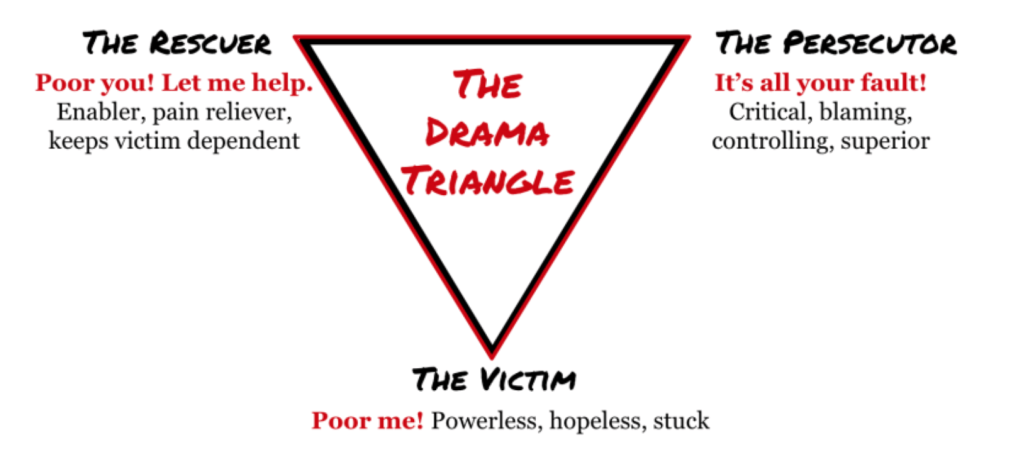
    Since I published the last part of my survival story, I was reflecting on the drama triangle on my other blog, Learning from the Streets,  which I wrote *obviously for youthworkers, like myself who can get stuck in that cycle.  Maybe it took the penny to drop a little bit.  To realise the extend to which the drama triangle was being played out in my childhood home, and also in more recent situations.  When I think about my own issues with codependency, they go back to the role I was expected to play as a child.

    Because, if the roles of Persecutor and Victim have already been taken, in the one psychopathic parent, and they control who assumes the other roles.

    I became the grown up child, like I said in my part 5, who took on the emotionally rescuing role, the ‘grown up’ , was told that I was the person that ‘could alleviate’ the emotional pain of the psychopath parent, and so, along with the eggshells to be aware of, I also became attuned to the moments where I had to step in and perform the rescuing duties.

    When the psychopath shifted from persecutor, to persecuted, the role of rescuer needed to be filled, and significant guilt/expectation was made, its not like I was able to say no.

    Seen through a drama triangle, the Emotionally immature parents distorted narrative of relationships is one of endless conflict; the strong exploit the innocent, who then suffer and deserve to be rescued by someone else.  (Lindsay C Gibson, 2019)

    What this meant, as I said in the previous part of this story, was surviving emotionally alone. Though I will say, that I was rarely cast as victim in the cycle, the persons who bore this weight, was my younger sister, and also, any other female in the family too, who my psychopathic parent had to continually be superior over. If my sister was victim, or even persecutor when she kept boundaries herself, then I was tasked with playing rescuer.

    When I was about 10 or 11 I remember a time when my parent, who maintained a level of control by being a primary school dinner lady (that’s what they were called in the 1980’s)  was hit by a football in the playground, or fell over and damaged her arm, it ended up in a sling. I remember the incident, because of the level of upset I felt about it. I remember my teachers trying to reassure me, that my mums arm would be ok. What I remember is that my over reaction to this incident emotionally was that I felt guilty for not protecting her, I, as a 10 year old, hadn’t stopped the ball, or the fall, or whatever it was. That was the reason for my reaction, I hadn’t fulfilled my role as rescuer. Was I about to get into trouble from the over emotional parent for not protecting them?

    In an emotionally toxic family upbringing, where strong persecutor and victim roles are taken, then rescuer was the only ‘safe’ place for me to be, not that I realised it at the time. But what that meant was having all the emotional responsibility, though that wouldn’t be admitted to (that would require a level of self reflection from someone incapable of it) .

    What I didn’t realise at the time (well who would as a child) was the extent which this drama was played out, neither did I realise that having to take on this responsibility as a child was emotionally abusive, and done behind closed doors.  It shouldn’t have happened, but thats what psychopathic parenting does.

    Surviving meant rescuing, but then what I did was shut down. When I began to realise how draining and destructive this was, I stated to shut down, so that my psychopathic parent did then receive any emotion from me. I went rigid and gave her no emotion, whether anger, or joy. Detaching from my emotions in that unsafe space was what I had to do to survive. I know now, my core self was protecting itself. Putting up an internal boundary to protect the inner child in me that had barely been seen or nurtured.

    Part 6 of my survival story is about me recognising how I developed into the role of child healer and rescuer. Part of my survival story, was about trying to make things better in the family, doing the emotional heavy duty lifting, and ‘trying to make things better’ when actually there weren’t adults in it taking any emotional responsibility for themselves. Surviving meant being responsible for others in a drama triangle that they were creating.  Part of my healing now, is to stop myself taking on responsibility, becoming aware of codependency, constructing boundaries and practicing emotional health.


    (A client remarked) he’d spent his adulthood trying to let go of his past, and he remarked how ironic it was that he had to get closer to it in order to let it go. (Kolk , The Body keeps the Score, 2014)