Tag: shame

  • Sorry Brene – I got you wrong

    Ive got to admit I didn’t really want to like Brene Brown.

    Her name had been banded around for quite a few years, usually by the phenomenal women that I know…and on the ever shared many internet memes and quotes, there probably isnt a week that goes by when a Brene Brown quotation hasn’t crossed my path in the last few years.

    But I didnt want to delve in to the Brene Brown popular phenomenon.

    So I figured I didnt really need to read her books or listen to her stuff.

    I mean, everyone is doing the self-help guru act and isnt she just like other people – an American female Matt Haig.

    Im sorry to admit… I was maybe a tiny bit American self help prejudice…

    So, dosed up with Lemsip, a laptop, and after a week of self reflection, I took a step of vulnerability and gave her TED talks a watch last weekend.

    Opened myself up to the possibility of what she might be saying… 11 years after it was recorded… (up until last weekend my TED talk watching has included 5 in total I think – yeah I know)

    I was pleasantly surprised.

    Here was someone who spoke the language of academia – not mushy self help

    (Then again would she be on a TED talk otherwise..?)

    Here was someone who was both self effacing, witty and wrestling with herself in the process of the research

    Someone who was warm.

    Someone who spoke and made it possible for me to feel like she was talking to me—- oh hang on James, really?

    Yes..because she was trying to hide herself behind her ego knowledge. Being known for knowing things.

    And that was me.

    The clever one at school – who couldn’t dance….who tried to do sports

    The clever one – who found academia…

    I was probably avoiding Brene Brown…because I kind of knew that I would like her, and like what she was saying, about shame, vulnerability and relationships.

    She ends the second of her two TED talks with a shortened version of this quote:

    What do you think of this quote?

    I love and hate it at the same time. I love and hate it because it asks something

    Its about showing up, with a raw vulnerable self

    In my relationships with my wonderful partner, my fabulous children and also friends and my work colleagues

    Not avoid the arena, to not just be the critic from the side (and isnt so much of media the critic?)

    Its easy to stand from the edges and criticise – but life isnt a non participation sport – not life in its fullness

    Participation in life is a messy action, where feelings are felt – not numbed…

    Daring greatly

    As Brene had done herself – from academic critical thinker, to therapy chair and breakdown (sorry, Spiritual Awakening)

    So I was doing my best to stand on the edge of the arena when Brene Brown is on the stage, and her books are available. Rather be the critique from a distance, than entertain the possibility that id be vulnerable to admit resonating and liking what she might have to say.

    Theres something else too. Its not just about showing up on the arena, in full view.

    Its about showing up to ourselves.

    When the only critic is ourself – often the worse critic of all

    The one critic that we might need to talk to as much as the external critics too. Tell to STFU every now and then.

    So, thank you Brene Brown. Thank you TED for being an incredible resource on You Tube, Thank you 5 days of cold/flu which has given me time to delve into them.

    I got you wrong Brene, and I’m grateful that I found you at the very right time. Vulnerability and Shame might be what the next phases of my life are about. So, thank you.

    Have a look on TED for Brene yourself…I dare you greatly…

  • Confronting Shame No 1 – Don’t be weak Emotionally

    I took a while to do this.

    A very long time in fact, because I had conditioned myself to numb the pain, to survive and also that I had only my own resources to get through things.

    You might imagine, that in having supportive parents you might find there shame in getting to the point where your marriage had broken down – but at least you’d be possibly assured of support afterwards. Imagine having the opposite. Imagine what its like knowing that you’d have to manage their emotions when you’re going through your stuff. So you dont bother.

    So I learned to pretend.

    Imagine being in a faith culture- being in churches, working for churches, being a youth worker, being well known – and also having to hide, numb and pretend that the reality doesnt exist. When you think, that everyone else thinks, that you might be happy and ok – but they dont ask and I avoid being asked.

    It took me a long while to know that doing this for more than 20 years. It took me the same length of time to try and bring to light childhood horrors into the open either.

    Why?

    Why couldn’t I do this?

    Why when ‘Vulnerability’ hit me like a drug in early 2019 it was like a refreshing new thing, but was as if I couldn’t help but tell bits of my story, the real stuff.

    Shame, as Brene Brown says, is the belief that we might not be accepted in loved – if our truth is revealed.

    Talk to me about the things that I was good at – and good at ‘despite’ my parents, and maybe thats the thing, if Brene Brown is right – then shame is “I am Bad’ rather than ‘I do bad things’ – somehow I had been gifted the shame of being responsible for the situation I was in, because of being a child of narcissist parents, it could never be their fault or responsibility…so whose might it be..yup..mine.

    In his book The Courage of Hopelessness, Slavoj Zizek writes in the first few pages about the ethical dilemma of those who smoke cigarettes but can give up, and the moral ethical dilemma of the ‘choice’ of giving up, the freedom to give up, and also the imperative to, going on to say that its only when someone is desperate, on their sick bed, and at the pit of hopelessness do they realise that they have no choice but to, for their own survival, that they do. I am yet to read more of his book, but this in the first few pages stuck. Survival Shame meant, for me, just keeping going, getting through it, same patterns, same torment, same gnawing unhappiness, same abuse, until the desperate me had to ask for help.

    Richard Rohr talks about a vulnerability moment, a breakdown (Falling Upwards)

    Eckhart Tolle describes his own, aged 30 (The power of Now) , as does Brene Brown herself.

    It took hopelessness – to get through the layers of shame.

    I couldn’t see things whilst I was hiding in and amongst it.

    Though I was right about the parents, and at the time so glad I was somewhere actually emotionally safe.

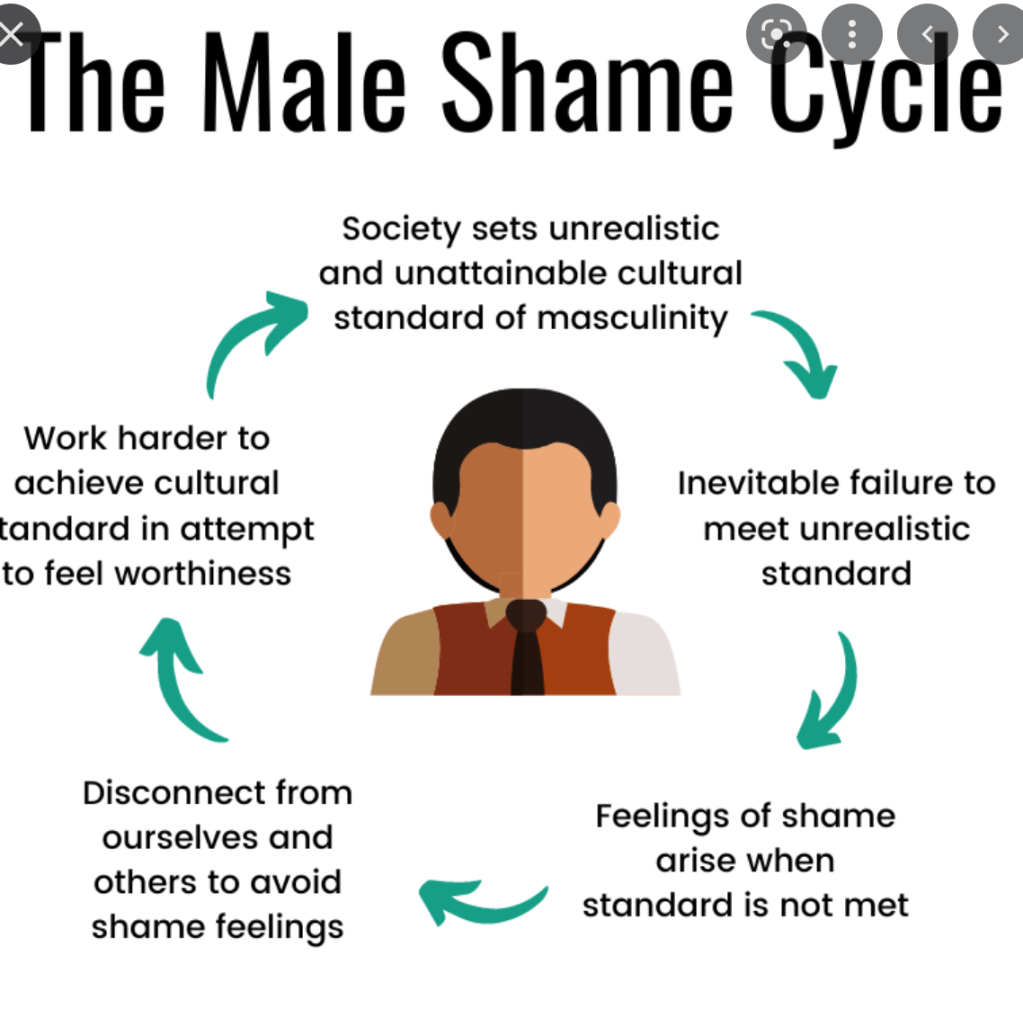
    Back to Brene Brown – in her TED talk I referred to in my previous blog, she talked about the 4 aspects of society that Men have to live up to ‘to be a man’,

    Emotional Control,

    Status,

    Job

    and Violence…

    Well I re watched it again yesterday with Christelle, and realised Brené said something else:

    For Women, Shame is

    Do it all, Do it perfectly and never let them see you sweat

    For Men, Shame is just one thing:

    Do not be perceived as weak

    Brene Brown (TED, 2012)

    In the area of Emotional control, one of the fours aspects above that Men have to live up to – how does being weak in this area bring about shame?

    are you any of these..I might be

    I know I can be ‘open’ like this – but I know I struggle to show emotions and be emotional even with people I feel safe with

    I didnt want to look weak – by going to therapy – and yet im going back for more

    I would prefer to fix than ‘not know’

    I would rather hide and pretend than admit I need help

    Being vulnerable – genuinely vulnerable is a weakness

    No one at work had better know if im struggling – I couldn’t bear it

    People like me, dont talk about struggles – we’re always ‘fine’

    Numb your own pain – those emotions are not as important as other peoples

    In my job I look after other people – I have to stay strong…

    Dont be soft, you’ll get walked over

    What might you add to this list? What might you have said to yourself?

    If Emotional control is one of the expectations – and fear of being weak the main shame for men – what might this look like for you.. what does it look like for me?

    You might ask about whether you need to have an awareness breakdown moment before realising that there is a different way to be about shame and vulnerability – and in truth I do not know the answer, that may be down to your attachment style (healthy) and childhood and all the coping mechanisms – and whether you have places to be emotionally safe. Maybe you dont need to have a breakdown and get to being hopeless to start making the change – maybe you were brought up with good acceptance of your emotions as a boy from family and friends. Only you reading this know.

    It could manifest in the fear of needing to be looked after, or the fear of having to ask for help, or not giving away our emotions, or staying in survival mode, or distract from real feelings mode, or taking medications to numb the pain…

    Vulnerability isnt a weakness – it is part of our every day lives – its risky and scary – it is part of who we are- and that includes us as men too.

    This is possibly part 1 in a series on vulnerability, in which Ill write on the 4 societal aspects described above and share a little about how they have affected me, and possibly other men too.

    If you have a story to share about Shame, and vulnerability – and emotional control – do put it below or email me , and with your permission id love to share.

    Maybe its time to name the weakness, name that it is not weak, to challenge the culture in which this manifests – I deserve better, our boys deserve better, women deserve better – Society is better for healthier men in it.

    There is more on this in depth in this article https://www.redbookmag.com/love-sex/mens-perspective/interviews/a14409/brene-brown-shame-vulnerability/

    This piece in psychology today is also helpful, for parents and partners of boys https://www.google.com/amp/s/www.psychologytoday.com/gb/blog/revolutionary-thoughts/201708/men-in-relationships-3-keys-emotional-vulnerability%3famphttps://www.google.com/amp/s/www.psychologytoday.com/gb/blog/revolutionary-thoughts/201708/men-in-relationships-3-keys-emotional-vulnerability%3famphttps://www.google.com/amp/s/www.psychologytoday.com/gb/blog/revol

  • How does Shame hold you?

    How does Shame hold you?

    When we (Men) reach out and be vulnerable, we get the shit beat out of us… and dont tell me from the guys…but from the women in our lives

    So I started interviewing men and..

    You show me a woman who can sit with a man with real vulnerability – ill show you a woman who has done incredible work

    You show me a man who can sit with a woman who has got to the end of her tether and his first response isn’t ‘I unloaded the dishwasher’ but he really listens – because thats what we need – then ill show you a guy whose done a lot of work

    Shame is an epidemic in our culture

    To find our way back to ourselves in our culture we have to find out how it affects us, the way we’re parenting, the way we’re working, the way we’re looking at each other

    When asked what the things men have to do to conform with male norms in culture, research showed the following:

    • Always show emotional control
    • Make work a Primary goal
    • Pursue Status
    • Violence

    The antidote to shame is empathy, if you put shame in a petrie dish it goes away.

    Shame needs three things to grow exponentially, secrecy, silence and judgement – it can’t survive with empathy.

    If we’re going to find our way back to each other, vulnerability is going to be that path.

    It may be seductive to stand outside the arena, when im perfect and bulletproof…but that never happens, we bring ourselves as we are to the battle ‘

    (Brene Brown, TED Talk 2012 – https://www.youtube.com/watch?v=psN1DORYYV0

    I have spent the last week digging deep reflecting on vulnerability and shame, on guilt, on myself – and this brought me to the point of actually reading or watching something of Brene Brown, a name that to me had been only a social media meme, or someone who I hadn’t got around to yet.

    So I watched her two TED talks over the weekend. Whilst there’s so much to reflect on in full. Its these last few comments about Men that I highlighted above, that I felt it appropriate to share here.

    Lets look again. For a man in society to live up to cultural norms (in a US based research) it involves

    Emotional Control

    Primacy of work

    Status

    Violence.

    So shall we ask the question – do you agree or disagree?

    Or a better one – have you felt shame in not fulfilling these things?

    Or another – how much effort does it take to ‘go against’ them?

    What does shame feel like for you?

    Are you expected to be ‘in emotional control’ – around others who lose their shit – so what place do your feelings have?

    when was the last time you cried? When was the last time you cried, in front of your partner?

    Are you expected to work until – well until you are sick? Because you are meant to? Is your life about success at all costs?

    Status and power – Have felt the pressure or shame for not taking on that promoted role, or that position?

    Violence – Dont be the victim of bullying, stand up for yourself… fight back… – win at all costs ?

    Which of these resonates for you? Or might it be something else?

    If im honest I was shocked by these 4 things, especially Violence, but then whats the method in which superheroes win in films? or in video games? (as one example) – and it worried me that these were revealed as expectations and then areas in which Men might feel shame about, and realised that even if we dont think all apply to us – we can still carry shame because of just one of these areas.

    Maybe lets pause for a moment and reflect on the shame that we carry.

    What is it, and what is it doing to us that is likely to be unhealthy.

    What subliminal message about expectations and shame are we passing onto our children? What have we inhabited? What does shame and vulnerability mean for us, as men?

    I had to admit something to my partner Christelle the other day, she knows me as someone who is wise, clever, reads, who likes nature, adventures, travel and food, who is in work that involves justice, poverty and faith. I had to admit something, that feels like a guilty secret, in comparison of all these noble, creative, wise activities about me.

    And that was my also my following of sport. Specifically the capitalist business model team that is Manchester United – a team I supported since I was 8. My guilty pleasure, out in the open. But it felt almost shameful. Not liking football could be seen as odd in the UK, but that I support ‘that’ team (and not just because of recent results) seems so out of character with so many parts of me that I stand for. Though this felt trivial it wasnt in a way. It was a tiny bit of vulnerability on my part, a part of me that I often feel shame about, and hide, as it makes me feel less perfect, less with integrity, interested in something ‘trivial’. Though it sounded trivial, it still felt like a thing I felt shame about.

    In another example : I had to take a covid test today, like so many of us in the last 2 years – but can you remember how it was ‘shameful’ to admit getting this disease? Shame and blame in culture… – and yes I am writing this post whilst dosed up on lemsips and a bag full of tissues to hand – and the test has come back negative…

    Maybe thats the thing with shame and vulnerability – its about giving ourselves away, to hope that we’ll be loved despite our imperfections, and take a risk – where its safe to do so.

    So to the Men who might read this – what might shame and being vulnerable mean to you – what are you scared of, or afraid of?

    What cultures in work, or religious groups, make it even easier to hold on to shame- where our real lives can be hidden away for pretence or expectation – to not be our real selves..pretending…

    It might be time to bring it out of the secrecy, silence and judgement.

    Do the expectations of emotional control, stays, work and violence affect you? – in what ways?

    Is it one of these things more than the others? And who and how might you begin to expose the layers of some of the wounds of shame and let them go, in a way like Matt Haig describes below:

    Imagine forgiving yourself completely. The goals you didnt reach. The Mistakes you made -(the choices that you made even). Instead of locking those flaws inside to define and repeat yourself, imagine letting your past float through your present and away like air through a window, freshening a room. Imagine that.

    Matt Haig (The Comfort Book)

    Of course, the other side of this is those who feel no shame, the tiny proportion, but still large number who might be considered sociopathic. Shame is part of being human, part of being a human that is more whole and humane.

  • Its time to realise our wonderful bodies

    My body is wonderful

    And so is yours

    Have you ever noticed?

    Said those words, to yourself?

    Thought of your body as wonderful? Just as it is?

    Its no more wonderful larger, smaller, fitter, leaner, younger or older

    Because it is wonderful, just as it is.

    Have you ever noticed? Or stopped to?

    Then do so

    Why not try now?

    As you read this, with your mind open, wriggle your toes

    Feel your bones move, each one

    Your ankle and foot

    What is happening in your body as you wriggle your toes?

    Can you feel the movement? Can you tell?

    Your body is so wonderful it doesn’t tell you what it has to do every time you wriggle your toes

    or walk

    Every bone, cartridge, joint, muscle, tendon, all the fluids and skin

    As you read, your eyes watching, feelings deep within.

    That you can hear the noise of traffic outside as you do so

    your mind wondering

    did you forget your toes? Wriggle them again

    wriggle them fast, slow, and feel.

    Seems ridiculous doesnt it

    but thats the point

    To feel our bodies.

    Why is ridiculous? We all have them, bodies. (unless you’re a robot reading this, and you’ve been made by a body)

    What else about your body is wonderful….

    all of it

    Trying to escape from them, keeps the pain in them

    Tormenting the body, to feel pain

    Shame, blame, pain locked deep within, a carcass we thought nothing of.

    Our bodies are wonderful

    For what they are

    Sense it, enjoy it, feel it

    Its easy to forget, our body

    As just a tool to house our ever thinking mind

    As just a tool to pummel in the gym or working the land

    A tool to create life

    Reducing our body to a machine.

    As men, our gaze is often outwards to see the beauty in the female form

    But what about ourselves?

    Or the physical specimens of the sportsters and athletes, and we feel we cannot compare.

    So lets not.

    Lets give our bodies more healthy attention.

    Yes yours, and mine.

    A body so beautiful and complex, we will never understand, but we don’t need to

    Bodies housing all that shame, expectation, fear, guilt and pain, its no wonder we think so little of them.

    Undervalued by religion, the object of advertisers desires.

    Your body is wonderful, and so is mine.

    What it does and how it is held together, and how it thinks, feels, sense and communicates.

    Its never to late to start to love yourself for who you are, not just what you do, accomplish or create, but who you are, body included.

    Awaken the love of your body, listen to it breathe, feel it as it moves.

    Breathe life into it, feed it time, not just food.

    Treasure it, love it.

    Do the ridiculous thing, and think of yourself as having a wonderful body

    Try it…

    Stop reading…

    Wriggle your toes…and smile.

    And realise, just wonderful your body is.

    Though if you wanted to read more on this, try The Body keeps the Score by Van Der Kolk, or The Power of Now by Eckhart Tolle.

  • ‘Why cant I just have fun?’

    ‘Why cant I just have fun?’

    It sometimes feels an effort to have fun – dont you think? well it does for me

    Nothing is stopping me, I can do what I want, So what cant I?

    But then I started to realise why… its those voices in my head, the critical ones, the sensible ones…these ones…

    ‘Are you boys having fun?’

    Came the voice of the abuser to me, on a number of times, its often at a time when I have actually been having fun.

    Its tone was accusatory. It was as if ‘fun’ was not allowed.

    Fun was ‘found out’ – look you couldn’t hide it from me, you were having fun

    Secret fun.

    You doing have fun without me, you don’t have fun in this house,

    Isnt there something more useful you should be doing… like meeting my needs instead?

    Fun guilt.

    Just dont make a mess’

    Fun now has to be clean, organised, tidy.

    ‘I didnt say dont have fun, just keep the noise down’

    I gave up fun, fun was no fun..

    Another factor in the fun thing for me is the church thing.

    Growing up evangelical – meant having conditional fun, and being judgemental on other peoples fun

    ‘Look at us having fun without alcohol’ – at a barn dance that is excruciatingly painful in 1991 with other ‘young people’ who are finding it excruciatingly painful watching their parents dance and look as though they are pretending to be having fun and its just so awful. Then to be forced to dance. URGH.

    It wasnt just sex, drugs and rock and roll that were banned – it was anything that was the gateway to any of these things, school discos, pop music, smoking (anything) ..- we dont do what they do

    Fun for me as a teenager was doing ‘christian fun’ – what was allowed – the christian music festival – and yet even there I struggled to have fun, because I was so un easy about having fun, with the exception of sports, just dont get me to dance, or draw

    Problem is in a context of what is and what isnt allowed….nothing seems much fun

    If Fun is about doing something for the sake of it, doing something that might be boundless, free, creative and spontaneous.. then I realise that part of rediscovering myself, and my inner child is about ‘having fun’ again

    I can definitely see how having conditions on fun – meant that something wasnt fun

    I can see now also that as part of the trauma of growing up with a psychopathic parent, that fun wasnt part of the deal, because more than not fun was about being responsible, staying alert. The only fun was to do the thing they wanted to do.

    Theres only allowed fun in abusive narcissist prison.

    Guilty for having fun? Shame for having the wrong kind of fun? Too responsible to have fun?

    Too inhibited to get drunk, always needing to be aware, responsible and look after others..- yes

    So when did I start to notice this, and realise it?

    I notice all the time, id rather be serious, think about serious things, learn, write (like this), digest the news (see previous post), and even some hobbies can feel like a performance, competitive…

    I really noticed about fun when I asked my inner child what he wanted to do that was fun – and then actually do it

    It was my inner child that wrote what it above.

    I noticed too when it felt a momentous action to pick up a felt tip pen and make a messy splurge on a piece of paper.

    Dont make a mess, stick to the lines, you cant draw, dont be silly, that’s silly…voices in my head, every time

    Be a grown up, dont be childish, whats the point, haven’t you something more responsible, or helpful to do – like write a blog or check twitter or tidy, or…

    I realise that its a struggle to ‘have fun’ – when the voices in my head, the critical parent – from the sources of those critical voices, abusive people and excessively moral churches – have been so dominant, and Ive been conditioned to comply, to fit, and found belonging or a trauma bond in compliance.

    Overthinking fun makes it a struggle to have fun at all.

    Just need to do it.

    So one of those things is that fun is guided.

    What do I do now for fun? new things that ive never been interested in before… and also new things I didnt know I could do before, as well as some of the old things like trains, cycling and growing food, but also photography,

    Walks, and after those occasions a few months ago, now experimenting with drawing, art and self discovery in drawing, colours, and art – something I left behind as a child. Learning to be creative will be another piece, but at this stage, just to say that ive discovered something fun in stuff that I thought I couldn’t do or hated as a child. Its like an unlocking.

    PICK UP THE PENS JAMES. JUST DO IT..so..

    Heres something I drew yesterday, just for fun….and with both hands simultaneously…

    Safety is so important in the pursuit of creativity – unless you dont give a fuck about what it is you’re creating and potentially upsetting in the process

    So often emotional abuse resolves around the shameful control of behaviour and that includes ‘what is allowed as fun’

    Often those who cannot have fun project rules onto those so it prevents them from doing so.

    I do find it a struggle to have fun.

    Maybe thats an ‘adult thing’ – but I’m more sure its a recovery from narcissistic abuse thing too. Life was about survival – and fun doesnt play a part – (maybe except outside the prison walls)

    A few thoughts on Fun:

    I can relate. When you’ve been fighting for justice or for survival all your life, it doesn’t take much to be content. A safe place to live, some peace and quiet, can be enough for a while. Your idea of fun might just change a bit. (Ryan on Twitter @Ryan_Daigler)

    I think I feel guilty for enjoying myself? And also sometimes in the past bad things have happened to others whilst I’ve been out enjoying myself so there’s that.(Lydia @Lydimoo)

    and someone trying to..

    I promised myself I would do fun things while I’ve got all my evenings to myself during the school holidays. It’s not yet working out as planned, Ive killed alot of time playing games though (Helen @Helenmt)

  • Surviving Psychopathic Parenting (Part 13) Accepting the accusations of selfishness

    Surviving Psychopathic Parenting (Part 13) Accepting the accusations of selfishness

    Don’t you be so selfish

    You were such a spoiled child, I had to get that out of you

    Don’t you even dare even ask for that

    You need to think about things from my point of view

    Ultimately there is no avoiding this, with psychopathic, emotionally immature parenting, or a situation of emotional abuse, it’s the shame and accusations of selfishness that will get you in the end. The above applies to parents too, though you cant divorce them.

    They got me.

    Its funny when I think about it, The very thing the abusers cant do (think of others) is the very thing they accuse you of not doing, when you do it all the time.

    So what are they saying.

    Don’t you dare think about your own needs

    Or

    I am going to control you into doing what I ask, by making you feel shame.

    Emotionally immature people want you to jump when they call.

    They want you to rescue them.

    I was the rescuer, as I’ve written before.

    Terrified to say no as a child if that parent needed me.

    ‘No’ was harder than pretending.

    ‘No’ was harder than going through the motions

    I was accused of selfish if I didn’t meet their needs

    They were jealous if I met the needs of others. Furious even.

    They came first. It was their right and entitlement.

    A Childs dependency often irritates the self-involved parent. Preoccupied with their own issues, Emotionally Immature Parents can be short tempered and react to their Childs needs as if the child had done something wrong. Those parents make their children feel bad for having needs and thereby making the parents life harder.

    Lindsay C Gibson, 2019, pp41

    Surviving meant not having needs.

    It meant not disrupting the apple cart, or daring to crunch the eggshells

    It meant not asking, not requesting.

    Which is funny. Because unless we asked we didnt get, but often shame for asking (because I was at risk of being spoiled)

    This meant going without. Because there was no point in asking.

    I didnt go to them. For anything.

    I acted as though I didnt need them.

    I didnt even need them or go to them when my marriage fell apart.

    Better to hide.

    If you were treated in this way as a child, you may still feel ashamed for having problems or needing help

    Gibson, 2019, pp41

    Yup.

    Survival of the least neediest.

    Survival Alone.

    Knowing that any request to ask would be met with accusations.

    Knowing that any gift would be attached with manipulative strings

    Because they didnt give without strings, or give at all, then the threat of the accusation meant not going to them.

    Shame devastates.

    Action for Happiness

    I didnt bother going to them, my task was to comfort them.

    There was no way I wanted to be thought of as selfish.

    Especially someone who wasnt selfish at all. For some reason I had already learned to put others peoples needs first. Strange how I might have learned that.

    Such powerless anguish impels children to do something -anything- to make their parent respond to them. Thats why young children so often have meltdowns over seemingly insignificant things. They cant keep themselves together in the absence of supportive parental attachment.

    Gibson, 2019 p42

    I held my breath aged 2-4. Those were my meltdowns. ( I wrote more about these in the last part)

    Surviving Psychopathic parenting meant accepting the accusation. It meant accepting it and getting on with life without. It meant being learning to cope completely alone. What parent would give a snake, when a loaf of bread was asked for, said Jesus in Marks Gospel, well, some evangelical psychopathic parents shamed so much that I wouldn’t have even ask.

    Its ironic then that when they shamed for asking, they just take.

    You're not being selfish for wanting to be treated well. Remember that. -  BossBabe™ on Instagram | I don't own this image

    Thank you for reading, this is part 13 of my story, parts 1-12 are here

    Please do like and share this, and my other posts if its the kind of message you know will help others, there are a number of resources in the menu above too, and if you’d like to support me on this healing journey, please do click the link to the right too, thank you.

  • Unlearning the Evangelical Self Loathing

    Unlearning the Evangelical Self Loathing

    I dont deserve to feel warm

    (Me, aged 9)

    I cannot remember what I had done. But whatever it was I had been punished for it and then I felt guilt and self loathing afterwards.

    All your Sins can be removed if you accept Jesus into your life

    (Childrens worker, John Wilkes, 1989, at my church)

    Growing up in an abusive evangelical home, I was never far from self loathing.

    It couldn’t be anyone else fault that things went wrong, apart from mine. For some reason I was given the responsibility. It was my fault my parents were angry at me.

    By the age of 9 I was convinced that shame and guilt was for me to carry. By that age too I was aware of the eggshells I needed to walk on around my parents.

    I didn’t deserve to be warm. I didnt deserve the basic essentials.

    I already bit my nails so that they were infected and painful. That pain was a place of reality. That pain was safe.

    I didnt deserve to be warm either as I took all my duvets and blankets off that night, and it wasn’t summer.

    I didnt deserve.

    I didnt deserve the essentials. Any actual treat would be difficult to receive.

    Being convinced of my own guilt, and shame.

    Consequently given the chance to ‘remove that shame’ aged 11 I took it.

    But it never really was removed was it?

    It doesn’t go away.

    In fact in a strange way it becomes more of an obsession.

    The Cleansing of Sin game, also paradoxically means focussing excessively on sin, and shame, and guilt all the time. An increased opportunity for me to embed self loathing into my core.

    Self loathing is described here as:

    Self-loathing is that underlying feeling that we are just not good: not good enough, not good at this, not good at that, not good at – or for –much of anything.  It can be subtle, we may habitually compare ourselves to others, for instance, constantly finding fault with ourselves and putting ourselves down, with no real awareness that there is anything amiss. Or, we may listen intently to our critical inner voice while it scolds and berates us, telling us how embarrassing, stupid, or insensitive we are; refusing to challenge it even while we suffer from it.

    We may try to suppress this feeling of inadequacy by behaving as though we are superior to others; more intelligent, clever, intuitive, or attractive. It’s as though we have to prove that we are the absolute best in order to avoid the torrent of internal abuse waiting to pounce the moment we show any fallibility.

    https://www.psychalive.org/self-loathing/

    That I dont deserve

    Shame

    Continual guilt.

    If God wasn’t always watching me, then there was always eggshells going off at home.

    I dont deserve.

    Awareness of personal sin, that leads to self denial and self loathing, thats what was happening to me.

    I fell into the cycle, the trap. I wasn’t good enough, nothing I did was good enough, I couldn’t fix it, I dont deserve…

    At age 10 I was more sinned against and didnt have parents who took any emotional responsibility (let alone other responsibilities) , but that wasn’t the message in church. The message I needed to hear, and the one that ‘saved’ me as a christian, was one that tried to alleviate the undeserving feelings I felt. My sin. Yet, the greatest ‘sin’ I had was that I would never be good enough or meet their needs. It was less sin but guilt and shame I wanted rid of. But that wasn’t going to be possible.

    Not with psychopathic evangelical parents (and you can read my story above)

    The songs that I listened to, ‘christian music’ in the 1990’s were full of the same self loathing, that I was feeling

    What if I stumble, what if I fall, what if I lose my step and I make fools of us all

    (DC Talk, Jesus Freak 1991)

    Whats going on inside of me, I despise my own behaviour’

    (DC Talk, I want to be in the light, 1991)

    I am the only one to blame for this, Somehow it all adds up the same

    (Worlds apart, Jars of Clay 1993)

    Growing up evangelical meant being obsessed by personal shame and guilt. It meant also taking on the feeling of responsibility for not only my own failings but also where I had ‘failed’ to make things better for others, revolving around the perpetual needs of others.

    Self-Loathing | VESSELS of VISION

    Would I say I hated myself?

    Parts of me yes. Parts of me no.

    The intellectual trying. Trying to be the best. Trying to prove myself even more.

    Self loathing meant feeling shame.

    Perpetuated from how I felt.

    Scratching my body at times, twisting and pulling my hair out. All signs of the same. Comfort eating.

    A continual loop throughout most of my teenage years, though, continued until not that long ago to be honest, and unlearning it is so hard.

    Trying to say too myself that ‘I do deserve this, because I am ok’ is against 40 years of default.

    SELF-LOVE OR SELF-LOATHING?

    Lindsey Gibson in her book ‘Adult children of emotionally immature parents’ (2015) writes the following:

    Many internalisers subconsciously believe that neglecting oneself is a sign of being a good person. When self absorbed parents make excessive claims on their children energy and attention, they teach them that self-sacrifice is the worthiest ideal- a message that internalising children are likely to take very seriously. These children do not realise that their self sacrifice has been pushed to unhealthy levels due to their parents self-centredness. Sometimes these parents use religious principles to promote self sacrifice, making their children feel guilty for wanting anything for themselves. In this way religious ideas that should be spiritually nourishing are instead used to keep idealistic children focussed on taking care of others’

    (Lindsay C Gibson, 2015, pp120-121)

    The question is how do you unlearn this? How did I?

    Its step by step. Clocking it.

    Realising that gradually when I say to myself that ‘I dont deserve’ something, its a part of my, my critical voice, that has been active too long.

    Realising that as I went to the supermarket on Saturday after having a bit of a wobbly day, and trying to convince myself that it was ‘ok’ to buy myself cake, and a treat. Yes, I guess that having to second guess myself to treat myself, comfort myself, still shows that theres still a large of part of me that has a default of not doing so.

    When we are tired we are attacked by Ideas we conquered a long time ago

    Nietzche

    Or, maybe when we are tired, and finding it a tough day, we revert to the self talk of not that long ago, whilst we are still trying to embody a new way of being.

    Part of my breaking down and rebuilding started with recognising that not everything is my fault. Part of my healing has been to realise that I need not carry decades of responsibility. To not hold it any longer.

    My default of 40 years was to think I dont deserve.

    Maybe that is you too.

    I thought I didnt deserve what I needed. I though I didn’t deserve to feel happy. I felt shame, guilt and self loathing for what I continuously self internalised, encouraged and abetted by my parents and also the strand of evangelical christianity in which I had a strong identity and safety in.

    Part of healing is to name and be close to the things that were unhealthy, harmful and caused me (and you) to feel unhealthy, shame and destructive.

    So I just wanted to say to you, say to me.

    You do deserve it.

    Beautiful human you.

    Breaking down might mean breaking away from the self loathing.

    ‘You are enough’

    If that is the case, then let it go. Shed that skin. It wasn’t doing you any good, none at all.

    Time to wake up the real you.

    Its hard road Im on, unlearning 40 years of the same shame.