Tag: Survival

  • What if the story we live by, is a story we cannot tell?

    Something happened to you

    Something happened to you..that wasnt your fault

    Something happened to you…that wasnt your fault….and you had to do something as a result that you cannot talk about.

    Something happened to you..that wasnt your fault…and you coped in life with self soothing strategies…that you cannot talk about either.

    Something happened to you….that wasnt your fault….and everything since has been about staying silent about it…silent….and hiding all traces….protecting it….protecting yourself…from what happened to you.

    Something happened to you, by someone who is dominant, powerful and sometimes insane, and bewilders you from any kind of action, and you can’t share it, for recrimination.

    Something happened to you…..that you dont think anyone will believe.

    That wasnt your fault.

    That wasnt your fault.

    (even if their insanity causes you to take the blame)

    It was something done to you, when you..when I.. was a child, when I was powerless, when I was dependent…

    That set so many patterns of life in motion….

    And a story that had to remain silent.

    We live by stories.

    We all have a personal narrative, a myth, a sacred story to believe, a story to live by.

    David Macadam says in ‘Stories we live by’ that by having this personal story we then accept, reject information to fit it, or expand our story to fit the new information.

    That was one of the things I learned when I was doing my Masters in Theology and Ministry at Durham, the psychology elective that I did with Dr Jocelyn Bryan.

    In 2017, doing my Masters, I didn’t have a story I lived by, not one I wanted to talk about, it was far easier, a defence mechanism, to use my brain to disect and critique the process of story making, story telling and consider how theology, story and drama all fit together, whilst I was feeling, well, I wasnt feeling anything, just dying inside. Even the Christian story that I believed , I had critiqued and was full of doubt of it.

    Yet.

    That sacred myth that I doubted had to do a lot of work, to hold me somehow when my psychological self was a scared, wounded, abused little boy.

    The story that I was actually living by, twas a story of shame, a story of abuse, for fear, a story that I didn’t want to acknowledge.

    That was the story I was actually living by…

    Because it haunted my every step.

    It was the story that had power over me.

    It was the story that consumed.

    It broke me into a thousand pieces every day, causing…

    One trip to eat extra food every day

    One more hour watching TV news

    Three more glasses of wine

    One more hour on twitter staying distracted.

    One more week watching Friday night soothing comedy.

    One more piece of bread, then another, and another, and another

    One more football match to overlay drama with drama

    One more piece to write to stay busy

    Another long bike ride.

    More work to do, fill the diary.

    One more anything

    To run…

    Filling an ache.

    Because I was so not actually ok, that I could barely say the words, let alone say I had needs, because, that would mean being in a safe enough place where my needs were validated, even if I could articulate them.

    One more coping mechanism

    One more denial of my self

    One more day to mask and pretend.

    One more day when I couldn’t share, just keep going.

    Survival isnt a story, its fragmented existence.

    One more self soothe

    One more ‘fix others, im not important’ moment

    One more hope of change, living a story of ‘conditional okayness’

    Fear, alone, isolation.

    The story I lived by, for too long, was a story of shame, fear, anxiety and survival, and masking this so that no one could ever know.

    Shame.

    Ends.

    When stories

    are told

    in

    safe places. (Brene Brown)

    Yet.

    Shame stories

    Held

    me

    for too

    long.

    It was a story I couldn’t tell.

    It was a story I held in silence.

    It was a story that I had no control over.

    It was a story that wasnt mine.

    It was a story of what someone had done to me.

    It was a story of my coping mechanisms because of that childhood abuse and the follow up behaviour, including relationships.

    My life, was someone else story.

    My lifeless life was someone else’s story.

    How I had adjusted to be for someone else.

    How I had given away myself.

    Actually thats so not true. Because I had never had a self. Self was broken from birth.

    When real

    stories

    of us

    being alive.

    get hidden.

    There was a story I was living by. But it wasnt a story about me. It was a story about how my life was orientated around the fear of someone else, and that I was a bit part player in my own life.

    It takes so long for someone to feel the main player in their own story

    Spiralling into an anxiety I couldn’t never acknowledge. Tears hidden, as breakdowns occurred in car journeys all alone to Coldplay songs, and reduced priced Tescos wraps scoffed.

    In avoiding the negative, we only encourage it to recur (John O Donohue Anam Cara)

    I look back and realise how barely I even existed.

    To do self care, to have needs, to accept love, to do quiet, to give myself any permission, to feel power…all deemed unimportant, selfish or impossible, so invalidated all of them.

    So that story began to change.

    Or, my relationship to my story did.

    As i began to realise what was done to me, wasnt my fault.

    As I began to realise how I had been trapped in emotional contagion.

    As I realised that change on the inside brought a sense of worth, and change on the outside…

    As I began to realise how I hadn’t been loved, just stolen from.

    As I began to realise, how I had survived

    As I began to realise the damage, yet also the inner strength and resolve I had to get myself to where I have got to.

    As I began to work through every brave step, and own the bravery of it all.

    As I began to realise who I am, and who I am not

    As I began to connect with my story, to dig deep into it all, and realise myself in it all. I had ran from a past I had to connect with, to face, to love for my self strength in it all.

    As I took loving myself seriously, and self compassion, and self care, and just undoing the critical voice of inner torment. I had to love myself in a way that I had only been able to love others.

    As I began to realise my own…sense of worth….sense of love…sense of being me, wounded in many parts, but not entirely broken, and capable of love.

    As I started to be my own story. I started to be able to own the story, to make this story about me, to connect the dots, and also now, to be able to be excited about the blank pages ahead, waiting for their colours to emerge.

    As I started to write it down, and realise I wasnt alone.

    As I realised that there was life beyond it, beyond it all.

    But at the time, the story I wasn’t able to tell was the story that I was living by.

    What if the story we live by is one of abuse and the shame of what we do to cope, and the silence of both of these things?

    For, It’s not what happened to us often…it’s the silence and hiding for so long. It’s navigating a life around the shame. Thats draining and energy sapping.

    Yet, it doesn’t have to be this way, not forever.

    Sometimes the bravest thing you can do is to stop living the story that others wrote for you.

  • Surviving Psychopathic Parenting (Part 30) What 9 year old me had to Become

    So, I didn’t commit suicide aged 9. But everything was pretty dark.

    I survived to tell the tale.

    To tell my story

    To be my story.

    What did I do?

    Age 9, in those dark moments?

    At the time, I remember thinking that something didn’t sit right.

    That something was that however ‘normal’ I was being told my family was. It wasn’t good. Something didnt stack up.

    As well as an internal voice that did often tell myself that I wasnt anywhere as bad as I was being told I was – I was punished for far less than my friends were telling me they were – I also started to be affirmed by firstly teachers and then other adults – I began to assess that the voice of the toxic one might need to be listened to,

    but it didnt need to be believed.

    I wouldn’t say that id worked out that the problems that they said I was was their problem, thats too far – but certainly began to realise that the toxic voice didnt need to be believed.

    Read my previous post on ‘Survival Self-talk‘ here

    I think I did then realise that I had to do life alone, and with the positive support of my year 4-5-6 teachers (Mrs Prowse, Mr Poole and Mrs Smyton, at Little Bowden Primary school) I began to believe that I was clever, in an academic way, and had other qualities too, like listening to people and being able to be responsible. I was also sporty – winning cross country races and playing for the school football team, and it was sports that I developed more in the next few years too.

    Heres me aged 9 – 1987

    My grandparents took this photo, its obvious, im smiling – and i’m near trains…

    That combination intelligence and responsibility took me to do a number of things – one was to dedicate myself more fully to the church I grew up in – a place that was getting safer, as my parents left it when I was about 12-13, but from 11-12 I was helping in the Sunday school and doing practical things like setting up the chairs and the youth club. Oh by the way, the kid who stays back and puts the chairs away to be helpful every time… doesn’t want to go home – find out why….

    Without realising it, or maybe realising it was the place of the role I was in – with that responsibility, intelligence and desire to fix the thing I knew was broken – is that I became a bit like a mini priest or psychologist – trying to work them out, trying to work out how and why my parents got to be like it – trying to also navigate my own safety through it, but also making the suggestions or assertions to improve things; ‘Maybe we should go out for a meal’ (other families do that, we should) , ‘What about a movie night, or take away’ ‘what if we prayed together as a family’ ‘lets play a board game’ …. I remember also praying for my grandparents – thinking this was the thing I needed to do, to help them….

    Somehow believing that I could fix, something I couldn’t then understand – or even do something to make something happier than the normal constant eggshells.

    This, more often than not, was me suggesting these things, and guess who got grumpy at the thought of them – who would belittle, or patronise these suggestions? Agreed… But this became part of my role in the space of having no nurturing, growing up fast, growing up responsible.

    I realise that I couldn’t rely on the parents, it was now going to me getting on with my life. Once I got more and more freedom (a bike), and a job (a paper round aged 13) , access to learning at the school (libraries) and teachers who helped – I needed them less and less.

    I was wanting to do psychology A level when I was 16, my school didnt offer it. But that was no surprise, not to me now. Id studied human behaviour since I was born, never able to relax, trying to navigate the emotional blows and not give my abusive parent what they wanted, and stay sane and safe.

    I survived an emotionally abusive home by gradually realising more and more that I was less of the problem.

    That parent was good though, because the times I started to believe her less and back off, not trusting her even as a child with telling her things, she’d often come out with the line, ‘Dont you believe the gossip other people say about me‘ . How confusing was this to an 11 or 12 year old, parents dont lie do they? So everyone else is invalid, and whats a child going to say then – ‘No of course not mum’ especially while I’m in the house. The gossip was true though, and I knew it. Thats the thing, I learned to pretend.

    On pretending and hiding – this is here

    Maybe it didnt become a surprise that I became a youth worker, interested in psychology and now training to be a therapist. Not a surprise that my primary school teacher said that I was perceptive, from the age of 6. The magical or desperate ending didnt happen at the age of 9, I just had to work out how to deal with what I was being told, or not told, create distance from it, accept the positives elsewhere, and survive.

    Survive, so that 35 years later I am here sharing my story. Sharing a story of how emotional abuse nearly killed me. How a psychopathic woman destroyed a family and abused many around her. Survive, and now thrive, see and get close to the damage of childhood, get close to the child I left behind, get close to the child that was scared and frightened, and live closer to my core. There may not have been a magical escape, just seriously hard emotional work – but 35 years on im sharing my story, in a safe, happy, loving place – not afraid of the demons within, and taking the time to love the James who had to deal with so much in the only ways he could.

    Thank you for reading.

  • Healing started with me…

    I was ok

    It’ll be ok

    Ive always survived

    Ill get through this

    Another thing to get through

    Im ok

    But I wasnt

    I was hiding

    I was pretending to say things were ok

    Whilst parts of me were screaming

    and wanting me to face them

    But ill keep running

    or saying things will be fine

    or denying

    pretending

    making myself look as if im ok

    My red flags.

    My codependancy

    My trauma response

    My fear

    My hiding

    Running

    That monster is too difficult

    Its too big

    I don’t want to face it

    Id rather avoid

    run

    I had to change

    I had to face the reality

    I had to

    I

    Healing started with me

    not trying to run, hide, deny

    But to say

    I need help

    I dont know what to do

    I cant do this on my own

    I dont understand

    What I relied on doesnt work here

    Healing started with me.

    My insides

    That had burned

    That I had denied

    That were screaming to get out

    But id ran from the pain

    Healing started with me

    the stuff that would mean difficult choices

    the stuff that would mean I would have to be real

    No

    Please dont make me face

    that

    stop

    rest

    Healing started with me

    Not you, not everyone else

    not trying to survive

    but realising

    that

    life

    could be different

    life was possible

    real

    feelings

    I am

    loved

    worthy

    worth the effort to be real

    Me.

    Healing started with me.

    What did I need ?

    Who arrived to heal and carry me?

    Love me.

    Heal me.

    Be actual me.

    Healing started with me.

  • Surviving Psychopathic Parenting (Part 7): Why I have to thank Roald Dahl (but didn’t realise until last week)

    I was wondering a few months ago about whether there was any children story books written to help them see what domestic violence looks like, when it is against them, and by their parents. In Lindsay Gibsons book she refers to the many children stories of old that regail of how children survive and thrive, win and adventure without the help of parents, or against the abuse by ‘step’ parents, and you’ll know the Disney ones I mean. At the time I was reading, and am still reading Harry Potter, and though he is extremely abused by his adoptive Guardians, and is full of recollected grief for his own parents, he was not abused by them.

    What I realised two weeks ago was that I knew of the book.

    What I realised two weeks, minus 1 day ago, is that I knew of the book, because I had the book.

    What I realised two weeks, minus one day go, is that I read the book that includes many elements of the behaviour of my psychopathic/emotionally immature parents in it, whilst I was as child.

    Im sure there are other books out there, but the realisation that I not only had the book, read the book, I also loved the book, and I somehow even then saw something in me in the main character, whilst not completely seeing the extent to which the abuse she encountered at the time. But then again, my brain was probably doing its protective thing and not seeing it.

    So reading it again and Im seeing:

    At this point ______ entered the room. He was incapable of entering any room quietly, he always had to make his presence felt immediately by creating a lot of noise and clatter. One could almost hear him saying ‘Its me, Here I come, the great man himself, the master of the house, the wage earner…

    From the main characters Parents.

    When confronted by the Parents, the teacher has to develop all the required tools to deal with narcissism, like not using anger, staying cool, being firm, creating boundaries and not rising to their bait. It was amazing to read in a childrens book, all the techniques I’ve had to read in self help books on this (see the resources in the menu above).

    By now, youve probably worked out the book, its Matilda, by Roald Dahl, published in 1988.Matilda (novel) - Wikipedia

    Later after we have encountered the head teacher at Matildas school, Miss Trunchbull, we see that in the words of a 5 year old child, we see emotional intelligence and perception so beyond her years, and in Matildas words, the pattern of the entitled , narcissist is revealed. After an incident in which the Trunchbull throws a girl in pigtails, by the pigtails over the school fence, there is this conversation;

    How can she get away with it? Lavender said to Matilda ‘Surely the children go home and tell their mothers and fathers.I know my father would raise a terrific stink if I told him the headmistress had grabbed me by the hair and slung me over the fence’

    No, he wouldn’t  Said Matilda, ‘and ill tell you why..he simply wouldn’t believe you’

    ‘Of Course he would’ , Said Lavender

    ‘He wouldn’t ‘ Matilda said, And the reason is obvious. Your story would sound too ridiculous to be believed. And that is there Trunchbulls great secret

    ‘What is’ ,  Said Lavender.

    ‘Never do anything by halves if you want to get away with it. Be outrageous. Go the whole hog. Make sure everything you do is completely crazy its unbelievable. No parent is going to believe this pigtail story, not in a million years, Mine wouldn’t they’d call me a liar’

    Now obviously Matildas parents don’t see her, and view her merely as a scab (Page 2), but from her own words (or Dahls) we see the pattern of the self obsessed narcissistic parent, in the Trunchbull. The one who has no regard for the rules, for social rules of dignity and decency, of the human condition of the other. They are the law unto themselves. Doing actions so shocking, that evoke stunned trauma, and disbelief. That is the pattern of one of my parents.

    So why didn’t I see it? Maybe I did. Maybe I also saw what I had to do.

    As you may know Matilds draws on her inner guile, magic, knowledge and self to survive. I wonder how much this book, reading it at age 10 had on me at the time, subliminally, she was stuck between abusive parents and headteacher, and yet emerged with her own sense of self, and with one supportive adult that gave her the emotional space she needed to thrive, but also knowing she had to take responsibility for herself, because it wasn’t going to be from elsewhere.

    But if you want to see how to respond to entitlement, narcissism, and abusive adults, and educate and help children see it, then in my opinion you could do alot worse than use Matilda as an example. 30 years on, and I cant quite believe how accurate its descriptions are of behaviour I have witnessed in my whole life. Maybe the magic of Roald Dahl, for me was that he showed the ways of survival and also patterns of behaviour to the child.

    Yes Matilda had the help of some significant miracles to combat the Trunchbull in the heat of the storm, and get justice, and overcome her Parents, but so much else was about the inner strength and responsibility she took for her own life, being generally kind, grounded and diligent, and also having one trusting, supportive adult who also saw her, believed in her and gave her time.

    So yes, I have Roald Dahl to thank, because he gave me a hero that survived and thrived in the midst of the most emotionally toxic situations, and even though I didnt ‘see’ it at the time, obviously something completely resonated.

    Thank you for reading, this is part 7 of my Survivor Story, if you’d like to read from the beginning part 1 is here and the rest of the parts are in the menu above.


  • Surviving Psychopathic Parenting (Part 6) : Taking on the rescuing role

    Surviving Psychopathic Parenting (Part 6) : Taking on the rescuing role


    Dont you start playing victim!

    (because that’s the role I have in mind for myself)

    I cant cope with… what youve just said, what youve just done….

    (you’re expected to alleviate me, not challenge me, you’re supposed to soothe things…)

    You just need to take more responsibility

    (thats interesting, because ultimately, I’m taking all the responsibility, and I’m the child in the house) 


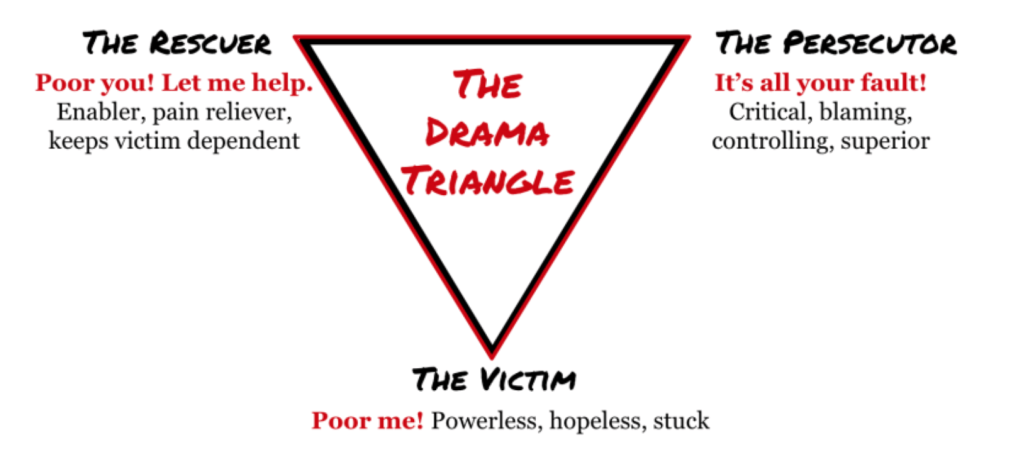
    Since I published the last part of my survival story, I was reflecting on the drama triangle on my other blog, Learning from the Streets,  which I wrote *obviously for youthworkers, like myself who can get stuck in that cycle.  Maybe it took the penny to drop a little bit.  To realise the extend to which the drama triangle was being played out in my childhood home, and also in more recent situations.  When I think about my own issues with codependency, they go back to the role I was expected to play as a child.

    Because, if the roles of Persecutor and Victim have already been taken, in the one psychopathic parent, and they control who assumes the other roles.

    I became the grown up child, like I said in my part 5, who took on the emotionally rescuing role, the ‘grown up’ , was told that I was the person that ‘could alleviate’ the emotional pain of the psychopath parent, and so, along with the eggshells to be aware of, I also became attuned to the moments where I had to step in and perform the rescuing duties.

    When the psychopath shifted from persecutor, to persecuted, the role of rescuer needed to be filled, and significant guilt/expectation was made, its not like I was able to say no.

    Seen through a drama triangle, the Emotionally immature parents distorted narrative of relationships is one of endless conflict; the strong exploit the innocent, who then suffer and deserve to be rescued by someone else.  (Lindsay C Gibson, 2019)

    What this meant, as I said in the previous part of this story, was surviving emotionally alone. Though I will say, that I was rarely cast as victim in the cycle, the persons who bore this weight, was my younger sister, and also, any other female in the family too, who my psychopathic parent had to continually be superior over. If my sister was victim, or even persecutor when she kept boundaries herself, then I was tasked with playing rescuer.

    When I was about 10 or 11 I remember a time when my parent, who maintained a level of control by being a primary school dinner lady (that’s what they were called in the 1980’s)  was hit by a football in the playground, or fell over and damaged her arm, it ended up in a sling. I remember the incident, because of the level of upset I felt about it. I remember my teachers trying to reassure me, that my mums arm would be ok. What I remember is that my over reaction to this incident emotionally was that I felt guilty for not protecting her, I, as a 10 year old, hadn’t stopped the ball, or the fall, or whatever it was. That was the reason for my reaction, I hadn’t fulfilled my role as rescuer. Was I about to get into trouble from the over emotional parent for not protecting them?

    In an emotionally toxic family upbringing, where strong persecutor and victim roles are taken, then rescuer was the only ‘safe’ place for me to be, not that I realised it at the time. But what that meant was having all the emotional responsibility, though that wouldn’t be admitted to (that would require a level of self reflection from someone incapable of it) .

    What I didn’t realise at the time (well who would as a child) was the extent which this drama was played out, neither did I realise that having to take on this responsibility as a child was emotionally abusive, and done behind closed doors.  It shouldn’t have happened, but thats what psychopathic parenting does.

    Surviving meant rescuing, but then what I did was shut down. When I began to realise how draining and destructive this was, I stated to shut down, so that my psychopathic parent did then receive any emotion from me. I went rigid and gave her no emotion, whether anger, or joy. Detaching from my emotions in that unsafe space was what I had to do to survive. I know now, my core self was protecting itself. Putting up an internal boundary to protect the inner child in me that had barely been seen or nurtured.

    Part 6 of my survival story is about me recognising how I developed into the role of child healer and rescuer. Part of my survival story, was about trying to make things better in the family, doing the emotional heavy duty lifting, and ‘trying to make things better’ when actually there weren’t adults in it taking any emotional responsibility for themselves. Surviving meant being responsible for others in a drama triangle that they were creating.  Part of my healing now, is to stop myself taking on responsibility, becoming aware of codependency, constructing boundaries and practicing emotional health.


    (A client remarked) he’d spent his adulthood trying to let go of his past, and he remarked how ironic it was that he had to get closer to it in order to let it go. (Kolk , The Body keeps the Score, 2014)

  • Surviving Psychopathic Parenting (Part 2) Why I broke my grandmothers clock.

    ‘Working with trauma is as much about remembering how we survived as it is about what is broken’ (Kolk, The Body Keeps the Score, 2014)

    I broke my grandmothers bedside clock.

    I didn’t kick it, throw it, sit on it, drop it or smash it with a hammer.

    At age 4 or 5, over the course of a few nights/mornings whilst staying in my grans front bedroom, I took it apart, prizing open the backing, and then discovering a world of cogs, levers and springs, I think it was a wind up one, but that part of my memory fails me, and that’s not a surprise, though I don’t remember that it had a battery, and it kept time. It was one that looked a bit like this: Safari travel alarm clock, 1960s

    Sort of circa 1960’s travel clock.  Gradually, and without tools I think, unless I found a small screw driver around (and that was likely given what my grandad hoarded and that my dad had tools in his van) I prized open the back of the mechanism and then began to watch at first, then piece by piece remove the springs, cogs and everything else that was inside. If you’ve ever seen the film HUGO

    And yes of course I couldn’t put the clock back together again, and I probably also left springs and cogs out on the bedside table, with the intention of at least trying to fix it.

    I think I was smacked for breaking the clock. I was also smacked for not being able to say sorry for breaking the clock.

    But I wasn’t sorry for breaking the clock. I hadn’t broken it, well, I may have broken it, but I was trying to work out how it worked.

    At age 4, I was already in curiosity, perceptive, brain engaging mode.

    Repeatedly told off for acting spoiled and strong willed as a toddler, I used to hold my breath until I went blue, when my brain kicked into gear, I sought about trying to find out how things worked, and not only that, I realised by then that I had to stay alert.

    Be alert and of sober mind. Your enemy the devil prowls around like a roaring lion looking for someone to devour. (1 Peter 5)

    If part of recovering from trauma is telling the story of how I survived, then this part is about realising that I survived because of my brain. If, as was the case, that there was not going to be any emotional connection with my psychopathic parents, nature or support, which I clearly knew by this age, then my survival was going to rely on my own resources, my own brain to work things out, and to be alert.

    My curious mind grew. And so, even though I was then discipled for being ‘smart’ at later occasions (they do find the strong parts in you to reduce/minimalise, and the weak parts to humiliate often dont they?)  I set set out trying to discover how the world worked.

    Also, what I realise now, is that I was golden child. That part was obvious. So, laden in any discipline I received was a sense of shame that I brought to my parents, and the effect it had on them, their golden child, that they showed off (to my grandparents, and aunties) , was also the breaker of the clock.

    From then on I wasn’t allowed to touch anything electronic…

    ‘You might break it’

    Ironically, It took a lot of care and attention to detail to break that grandmothers clock, it wasn’t heavy hands or clumsiness, probably at least 4-5 hours of work some evenings and mornings while everyone else was sleeping.

    So, it was so unlikely that I would break something else, but from then on I wasn’t allowed to touch something.

    Not even the remote control on my other grandparents new VHS, just in case. Ironically I was the one that my parents actually had to ask to work out things, like our own VHS, Microwave (when I was allowed to touch it)..

    Dont touch you might break it.

    The problem is that you need to know how things work so that you can see them for what they are. Its no wonder that survivors of traumatic parenting go into care work, psychology or similar professions (and everyone in my family has), their skills have had to be honed, naturally by the emotionally abusive. They, like I, have spent hours trying to work out why and how things worked.

    That started for me when I broke my grandmothers clock.

    Part of surviving psychopathy, was, and is, about trying to find out how they operate, how they work, what is it that makes them do what they do, what the patterns are. Part of their game is to stop you from from working them out.

    How I survived my psychopathic parenting, involved attuning my practical and intellectual brain into gear, whilst my emotional brain shut itself down. I had already at this point realised that being emotional wasnt worth it, might as well work out how the world works instead.

    If you missed Part 1, it is here.