
‘Working with trauma is as much about remembering how we survived as it is about what is broken’ (Kolk, The Body Keeps the Score, 2014)
I broke my grandmothers bedside clock.
I didn’t kick it, throw it, sit on it, drop it or smash it with a hammer.
At age 4 or 5, over the course of a few nights/mornings whilst staying in my grans front bedroom, I took it apart, prizing open the backing, and then discovering a world of cogs, levers and springs, I think it was a wind up one, but that part of my memory fails me, and that’s not a surprise, though I don’t remember that it had a battery, and it kept time. It was one that looked a bit like this: 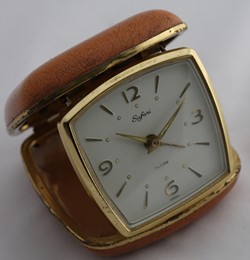
Sort of circa 1960’s travel clock. Gradually, and without tools I think, unless I found a small screw driver around (and that was likely given what my grandad hoarded and that my dad had tools in his van) I prized open the back of the mechanism and then began to watch at first, then piece by piece remove the springs, cogs and everything else that was inside. If you’ve ever seen the film HUGO…
And yes of course I couldn’t put the clock back together again, and I probably also left springs and cogs out on the bedside table, with the intention of at least trying to fix it.
I think I was smacked for breaking the clock. I was also smacked for not being able to say sorry for breaking the clock.
But I wasn’t sorry for breaking the clock. I hadn’t broken it, well, I may have broken it, but I was trying to work out how it worked.
At age 4, I was already in curiosity, perceptive, brain engaging mode.
Repeatedly told off for acting spoiled and strong willed as a toddler, I used to hold my breath until I went blue, when my brain kicked into gear, I sought about trying to find out how things worked, and not only that, I realised by then that I had to stay alert.
Be alert and of sober mind. Your enemy the devil prowls around like a roaring lion looking for someone to devour. (1 Peter 5)
If part of recovering from trauma is telling the story of how I survived, then this part is about realising that I survived because of my brain. If, as was the case, that there was not going to be any emotional connection with my psychopathic parents, nature or support, which I clearly knew by this age, then my survival was going to rely on my own resources, my own brain to work things out, and to be alert.
My curious mind grew. And so, even though I was then discipled for being ‘smart’ at later occasions (they do find the strong parts in you to reduce/minimalise, and the weak parts to humiliate often dont they?) I set set out trying to discover how the world worked.
Also, what I realise now, is that I was golden child. That part was obvious. So, laden in any discipline I received was a sense of shame that I brought to my parents, and the effect it had on them, their golden child, that they showed off (to my grandparents, and aunties) , was also the breaker of the clock.
From then on I wasn’t allowed to touch anything electronic…
‘You might break it’
Ironically, It took a lot of care and attention to detail to break that grandmothers clock, it wasn’t heavy hands or clumsiness, probably at least 4-5 hours of work some evenings and mornings while everyone else was sleeping.
So, it was so unlikely that I would break something else, but from then on I wasn’t allowed to touch something.
Not even the remote control on my other grandparents new VHS, just in case. Ironically I was the one that my parents actually had to ask to work out things, like our own VHS, Microwave (when I was allowed to touch it)..
Dont touch you might break it.
The problem is that you need to know how things work so that you can see them for what they are. Its no wonder that survivors of traumatic parenting go into care work, psychology or similar professions (and everyone in my family has), their skills have had to be honed, naturally by the emotionally abusive. They, like I, have spent hours trying to work out why and how things worked.
That started for me when I broke my grandmothers clock.
Part of surviving psychopathy, was, and is, about trying to find out how they operate, how they work, what is it that makes them do what they do, what the patterns are. Part of their game is to stop you from from working them out.
How I survived my psychopathic parenting, involved attuning my practical and intellectual brain into gear, whilst my emotional brain shut itself down. I had already at this point realised that being emotional wasnt worth it, might as well work out how the world works instead.
If you missed Part 1, it is here.
 James Ballantyne
Leave a comment