
Dont you start playing victim!
(because that’s the role I have in mind for myself)
I cant cope with… what youve just said, what youve just done….
(you’re expected to alleviate me, not challenge me, you’re supposed to soothe things…)
You just need to take more responsibility
(thats interesting, because ultimately, I’m taking all the responsibility, and I’m the child in the house)
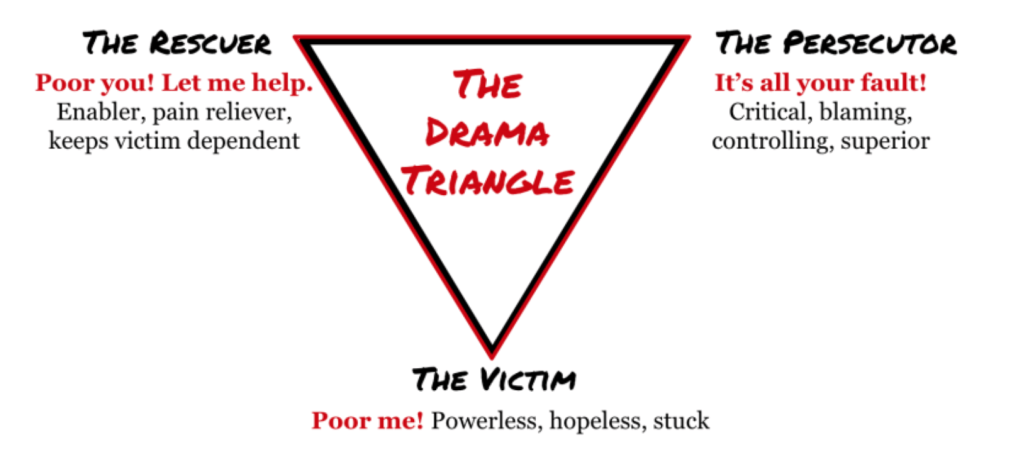
Since I published the last part of my survival story, I was reflecting on the drama triangle on my other blog, Learning from the Streets, which I wrote *obviously for youthworkers, like myself who can get stuck in that cycle. Maybe it took the penny to drop a little bit. To realise the extend to which the drama triangle was being played out in my childhood home, and also in more recent situations. When I think about my own issues with codependency, they go back to the role I was expected to play as a child.
Because, if the roles of Persecutor and Victim have already been taken, in the one psychopathic parent, and they control who assumes the other roles.
I became the grown up child, like I said in my part 5, who took on the emotionally rescuing role, the ‘grown up’ , was told that I was the person that ‘could alleviate’ the emotional pain of the psychopath parent, and so, along with the eggshells to be aware of, I also became attuned to the moments where I had to step in and perform the rescuing duties.
When the psychopath shifted from persecutor, to persecuted, the role of rescuer needed to be filled, and significant guilt/expectation was made, its not like I was able to say no.
Seen through a drama triangle, the Emotionally immature parents distorted narrative of relationships is one of endless conflict; the strong exploit the innocent, who then suffer and deserve to be rescued by someone else. (Lindsay C Gibson, 2019)
What this meant, as I said in the previous part of this story, was surviving emotionally alone. Though I will say, that I was rarely cast as victim in the cycle, the persons who bore this weight, was my younger sister, and also, any other female in the family too, who my psychopathic parent had to continually be superior over. If my sister was victim, or even persecutor when she kept boundaries herself, then I was tasked with playing rescuer.
When I was about 10 or 11 I remember a time when my parent, who maintained a level of control by being a primary school dinner lady (that’s what they were called in the 1980’s) was hit by a football in the playground, or fell over and damaged her arm, it ended up in a sling. I remember the incident, because of the level of upset I felt about it. I remember my teachers trying to reassure me, that my mums arm would be ok. What I remember is that my over reaction to this incident emotionally was that I felt guilty for not protecting her, I, as a 10 year old, hadn’t stopped the ball, or the fall, or whatever it was. That was the reason for my reaction, I hadn’t fulfilled my role as rescuer. Was I about to get into trouble from the over emotional parent for not protecting them?
In an emotionally toxic family upbringing, where strong persecutor and victim roles are taken, then rescuer was the only ‘safe’ place for me to be, not that I realised it at the time. But what that meant was having all the emotional responsibility, though that wouldn’t be admitted to (that would require a level of self reflection from someone incapable of it) .
What I didn’t realise at the time (well who would as a child) was the extent which this drama was played out, neither did I realise that having to take on this responsibility as a child was emotionally abusive, and done behind closed doors. It shouldn’t have happened, but thats what psychopathic parenting does.
Surviving meant rescuing, but then what I did was shut down. When I began to realise how draining and destructive this was, I stated to shut down, so that my psychopathic parent did then receive any emotion from me. I went rigid and gave her no emotion, whether anger, or joy. Detaching from my emotions in that unsafe space was what I had to do to survive. I know now, my core self was protecting itself. Putting up an internal boundary to protect the inner child in me that had barely been seen or nurtured.
Part 6 of my survival story is about me recognising how I developed into the role of child healer and rescuer. Part of my survival story, was about trying to make things better in the family, doing the emotional heavy duty lifting, and ‘trying to make things better’ when actually there weren’t adults in it taking any emotional responsibility for themselves. Surviving meant being responsible for others in a drama triangle that they were creating. Part of my healing now, is to stop myself taking on responsibility, becoming aware of codependency, constructing boundaries and practicing emotional health.
(A client remarked) he’d spent his adulthood trying to let go of his past, and he remarked how ironic it was that he had to get closer to it in order to let it go. (Kolk , The Body keeps the Score, 2014)
 James Ballantyne
Leave a comment