

As a youth worker you get to hear alot of stories and moral panics about abusive or absent Dads, and the effect this has on children. It is often in regard to the behaviour of those children, especially in education or criminal contexts. Theres a cry for ‘better role models‘ – assuming that parental role models aren’t good enough. It is easy to blame the parents.
The same rhetoric was used in those ‘christian’ mid nineties evangelical circles too that I grew up in, anyone else remember the ‘Even if your Dad was ______, God is a perfect father’ type stuff. Usually the reference to a Dad being abusive or absent. Strange thing then, that during those times there was little critique on that ‘perfect’ father sending a son to die.
I digress, and the discussion on absent or abusive fathers doesn’t really need repeating here, only to note how pejorative it is, and only too often, sadly and tragically, how common this is, and with the misuse of concepts like ACES*, children and young people are predicted behaviour and outcomes based on this in state settings, and barely given a chance to be different at times.
But my experience is different. And so might yours be.
What about a boy raised by an abused Dad?
Ive just tried googling images for ‘Abused Dad’ – have a guess at what I found?
This:
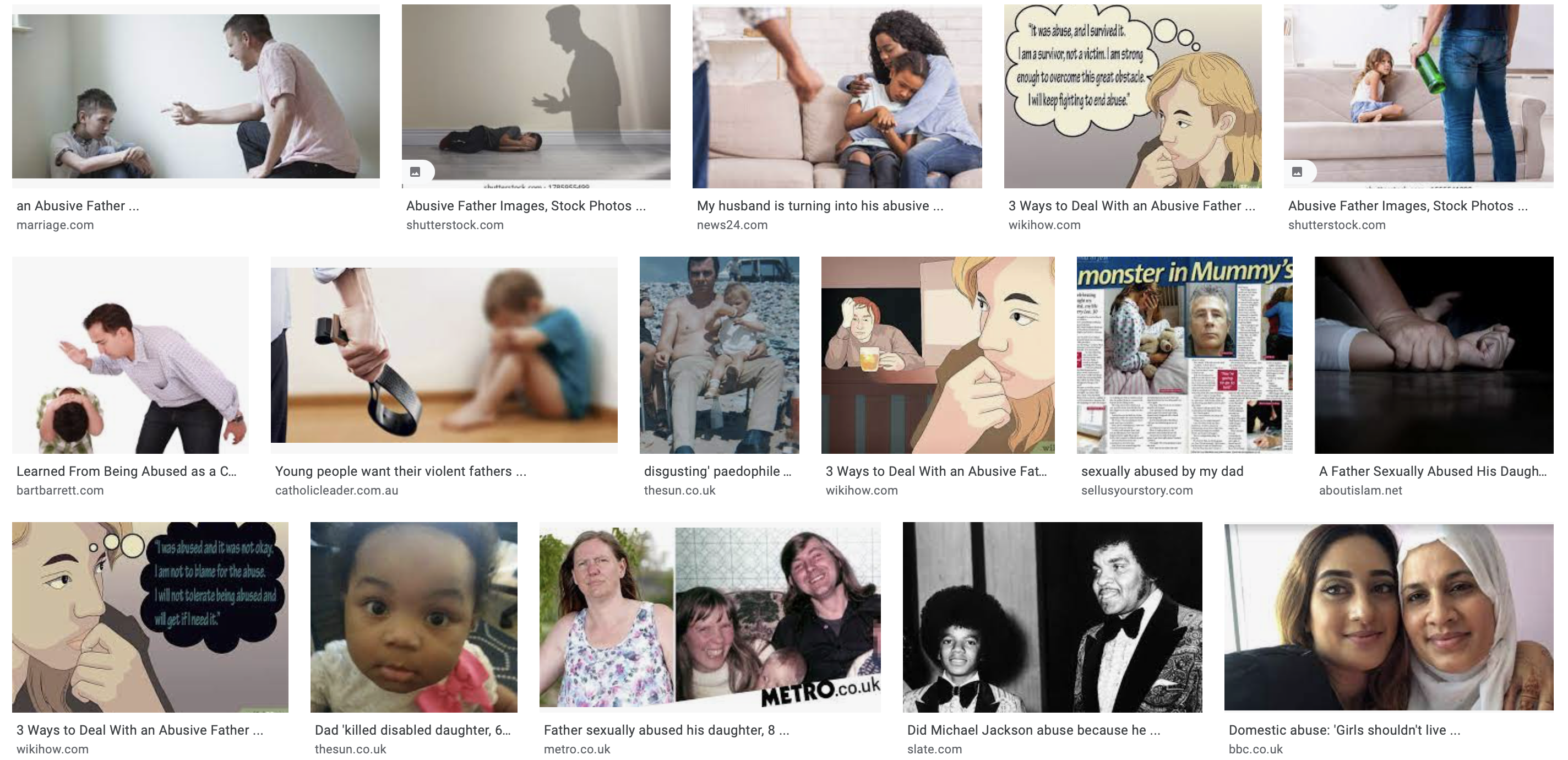
Note what emerges.
Article and article about Abusive Dads and Fathers. men who abuse their wives, their children, who dominate, hit, provoke, sexually abuse, financially abuse and the list terrifyingly goes on…..
Not Dads who are abused themselves.
I watched this a few weeks ago
In the TED talk above, Justin reflects on the qualities of his Dad, and how growing up he was determined to be different – Justin didnt want to be soft, kind and gentle – only to realise later that these were good qualities to have, and were part of his core.
So I pose myself the question; What kind of a Man did I learn from my own Dad?
Let’s start with the positives – everyone, outside, and some inside the family love my Dad. He would do anything for anyone, mostly in a practical way – fixing, decorating, making, constructing, he is softly spoken and rarely impulsive. He worked hard, and didnt cause or create any stress or drama.
But the rest of the time, he was a ghost. He was belittled and devalued, and threatened, walking on eggshells all the time. He could only obey the other parent, becoming the flying monkey, the accomplice, completely untrustworthy. He tolerated being lied to, by someone who was gaslighting him all the time. I dont remember him ever expressing his needs, ideas or dreams, and was told what to do nearly all the time. His invisibility extended to offering almost no nurturing or protection at all – deferring everything to the other parent, someone so sunk that they couldn’t be a healthy father figure at all. One who conceded.
I could go on, as there is more, and none of this is to be critical of him – given the extent of the manipulation he has suffered – this is more to reflect on what its like being Male, and a Dad, and growing up with an Abused Dad.
For one, there is almost nothing to read on this – even some of the emotionally ‘immature’ parent books defer to general characteristics of dominating Dad figures – and as I said above – try doing a google search.
Boys or Girls and their Abusive Mother figure may come up, but what are the effect on a child of their abused Dad?
What kind of Man/Masculinity did I see, and experience growing up?
Someone passive to women or others needs – no regard of their own
Someone with no role with their children
Someone with no voice
Someone weak
Someone who accepted being lied and pretended to
Someone who is weaponised by the other
Just a tool for someone else to get what they want.
I reflect on these, not with anger or bitterness, not with remorse or grief, but a sense of being in the process of understanding what the effect of an abused male care-giver had on my life – and not just an abusive female role-care giver. The abused dad rarely gets talked about, hen-pecked might be a mild term for emotionally manipulated.

I think what i’m trying to come to terms with is how challenging it is to try and talk about this, ‘some dads are abused too’ ..’some men are abused in domestic abuse relationships’ ‘some boys have emotionally abused fathers too’ – and what’s likely is that these situations are so likely to go under the radar. As that boy, might be kind, sensitive and attuned to the needs of others – and not themselves, that boy might be more likely bullied than a bully, that boy might like the quiet life, that boy might have issues with women – or find themselves in relationships with dominating women, that boy might struggle in a number of ways, but those ways might not be as evident as they dont fit the stereotype, if stereotypes are there to be fitted into anyway. They’re unlikely to be loud in a crowd and make a scene – getting attention.
That boy, might also struggle to know ‘how to be a man’ ….
When the female parent once told me to ‘stand up for myself’ it was ironic in that that was something she wouldn’t allow to happen to her, by my Dad. Stand up against bullies…but not the one in the home… a man is never right, a man always gives way, a man doesn’t have an opinion… oh and I knew I would have been punished had I hit that boy back….
I heard the advice as a teenager; ‘At least you’ll know how to treat a woman, given the way your Dad is‘ or words to that effect, and from a trusted source I internalised this, probably too much – to the detriment of treating myself, and being passive, putting myself lowest emotionally on the pecking order, because as I reflect I wonder how much that person saw and knew, and with the benefit of hindsight, the behaviour that has occurred 30 odd years since.
I reflect on also on the question of how all these things, and more, might be similar to children who grow up with the experience of their mum being emotionally, physically, sexually or spiritually abused, and what that is like for them, and whilst I clock it here as being highly significant and impactful in their life. This isn’t , as I say my experience, but I want to note it – and whilst its significantly more common, it doesn’t make it any less damaging on the child – this is in no way a comparison piece, but something I wanted to recognise.
There are plenty of cold maternal figures in the world, and plenty of female narcissists/psychopaths that go under the radar, yet alot rise in politics, business and also the church, and yet their damage to the men in relationships (and other females in their friendships) as well as their children is being more and more well known. What we don’t want to talk about is that Mothers have are cold, colder than ice, with only pretence of warmth, if that. So what might that mean for the Male parent, and how being the victim of domestic abuse , has on they children they have? – especially for their boys? What about the children, the boys, who get caught up the female narcissists loyalty games against that abused Dad? What kind of male/masculinity does that boy grow up with? What kind of insecurities might they have to deal with? What did I? The list is extensive – alot of written about already in my story above.
For the Boys growing up with Abused Dads – what is that like for you? What resources have you found to be helpful in this? Have you found some good articles on this – please do share them below, it would be great to have comments and conversation on this, if you want to get in touch and share a story or piece on this, do let me know.
And, to finish with that theological premise at the beginning, I can’t help but wonder what kind of God I internalised given the association that was made between earth and heaven Father figures.
Maybe this is a conversation we need to have – whats it like growing up with an abused Dad?
*ACES – Adverse Childhood Experiences
Thank you for reading this piece, if you would like to support me financially as I share, write and develop conversations that are Healing for Men, you can do so here, all gifts and donations appreciated Healing for Men

 James Ballantyne
Leave a comment