

Its ok to not be ok
But what if ‘norm’ was a depression that I didnt realise was?
I’m pretty sure now that I was depressed but I just didnt realise how this had been my normal experience.
Thats a conclusion I came to a month or so ago.
I had never thought of myself as being depressed, that was something other people experienced and not something I would want to or could conceive of being the lens to which I was experiencing life, maybe I was masking it.
But I can imagine now how a cloud, mostly grey, was being taken into every room that I was in, and, not intentionally.
Oh and I dont mean the obvious emotional breakdown moments, the teary moments that i’ve experienced in the last few years, as my emotions have welled up, have broken up through the layers of cold, hardened exterior.
I’m more talking about the cold, prickly, exterior. The despairing hopelessness. The Self doubt and beating myself up on the inside.
So let me wind back a bit.
I read two books back to back just before Christmas, whilst also being in the process of therapy. (I tell a lie, there were probably 5 books on the go…but anyways..) The first was Stolen Focus, and the second was Lost Connections, Stolen focus was the gateway for me into the writing of Johann Hari (ive written about Stolen focus Here on my youthwork blog, as this is all about play).
Lost Connections is Johann Hari’s personal exploration into his own depression story, how he was prescribed anti depressants as a late teen, the journey of medication, and his research into the causes, indicators and alleviators of depression.
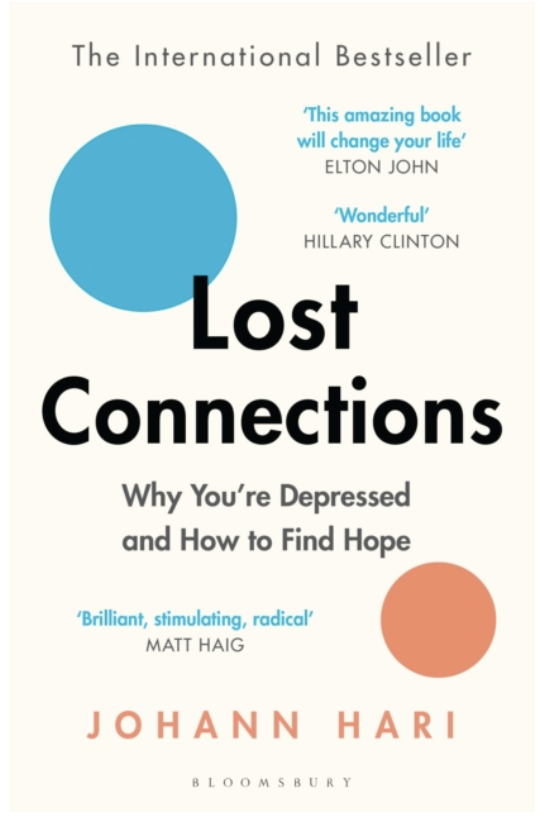
So, I read Johanns book with interest. But not with the thought that I was depressed, more that it intrigued me that he was going to talk about the importance of social relationships in mental health. But no, not that I was depressed.
Buy the book from Hive bookstores here: Lost Connections
If you’ve read my story (in the menus) you will know what’s coming, but it is very accurate to say that one of my survival strategies for dealing with a psychopathic mother, was to hide my emotions, including any semblance of happiness or joy. In fact I would go further and say that any moments of being happy were stolen: ‘I need to feel your joy for you passing your exams’ , and times when I felt happy outside of her influence were negated : ‘ I need to get all that toxicity out from when you were at grandmas’ – as there were and are photos of me smiling and happy at grandma’s. Any place where I was paraded or made an example of, I hid my smile, including family and school photos. If I was going to be on a mantel piece for others to see, it would not be with a smile.
Yet I was aware I wasn’t smiling. It was ok when other people took the photo, like church events or elsewhere, but if it was photo heading to the mantel piece or taken by her, no smile.
Thats just one example, there were many. But what it meant, and I knew that expressing any emotion was unsafe – it was stolen. Or I had to be responsible for soothing her emotions, yes thats what happened, me aged 5 and above was the one who soothed her upset ‘only you can make me feel better, not even Dad can’ was one message from when I was a child, a young child.
Talk about being emotionally tortured. It’s what I had to do. And also, this was a survival strategy, even if I didnt have a choice to do it.
It all makes sense now doesn’t it. It makes so much sense to the extent to which I was desperate, alone and wanted to end it all, aged 9. I wanted to wake up as someone else, failing that wondered what it would have been like to jump out of my bedroom window, or wait for a midland main line train to hit me. Aged fucking 9. Thats not normal is it?
Funny thing, when I tried to talk about this in starting my testimony at a church event in my teens (17) no one actually believed me, thinking that I was making it up as I didnt think I had a good ‘Jesus saved me’ story. But, folks, it was utterly true.
I couldn’t actually talk about how I was actually feeling, because I could hardly describe it, and very few people who I could talk to were safe, or would understand. It surely wasn’t normal to be scared of your own mother. But that was my normal.
But I was stony cold, prickly, critical and only able to let my head have any responsibility in how I was dealing with daily life. Not hard hearted, but wounded, heart hiding, protected. I was trying work out things, trying to work out how to cope, having to be one step ahead to know what to do in a situation, always trying to predict.
In some ways, this is all for me just ‘coping/survival’ stuff. I wouldn’t have categorised it as depression.
That was my normal, and if you’ve been in any type of abusive relationship you will know what that is like. Adopting to their unpredictable rage, strategising safety.
I wondered what it might have been like had I gone as a 10 year old to my GP and said, ‘is it normal to feel suicidal aged 9’? or ‘I feel like I have to hide my emotions around people who should be protecting and nurturing me?’ – but I didnt, anyway back to the book.
Oh, and one more thing, this actually was the thing.
I didnt know what I wanted to do with my life.
Throughout school, throughout my twenties, thirties even, ask me, and I didnt know.
My usual answer, was ‘Whatever God wants’ that was my get out, but that wasn’t what I wanted, I just didnt know.
I had no idea that not having any concept of a future was a sign of depression, a key sign. As Johann explains, it’s like the future is wiped away, inconceivable, as the present moment is the only valid space (and the haunted past) to attempt to survive in. Getting through. Making it out alive. One day at a time.
The other reason for me, was that my future was also something stolen. It was made conditional by that person again, as I had to do something to ‘make me proud‘ ‘not disappointing me‘ or I would have to ‘prove her wrong’ by things that had been decreed as things she was upset by. Stolen Future indeed.
Another indicator of depression, described in the book, was the lack of being in control. This is fascinating. In the book, research is conducted into 1,000 people all working in the same building, from the very top, to the bottom, CEO to the cleaners. It was found that depression was linked to those who had less control of what happens, in short, insecurity of the future was linked to depression. Being able to dictate and decide gave people more responsibility and stress, yes, but not depression, because they could see the way ahead and have some say in it, Insecurity led to depression.
It reminded me of Deci and Ryans work in that intrinsic motivators are linked to Relationship (connection/belonging) , Competence (being good at something/positive feedback) and Autonomy (being able to have decisions on the future) (in Human Being by Jocelyn Bryan) . I think this is extraordinarily interesting in relation to faith and systems of faith, especially in a time when status anxiety is rife. I’ll write more about this another time I think.
Anyway, back to me.
Well, back to the book to be honest, Johann outlines 8 ‘disconnections’ that are significant causes of depression, they are
- (disconnection from) Meaningful work
- Other people
- Meaningful values. (Capitalism and the need for stuff that kills the soul)
- Childhood Trauma
- Natural World
- Status and Respect
- Hopeful/Secure Future
- and ‘the Role of Genes/Brain changes in depression’.
Each of the chapters is utterly fascinating, each is woven with his own personal story of what he needed to alleviate his own depression, something to blame, something that wasn’t himself, a chemical (low serotonin- this is a myth btw), a story. But each of these ’causes’ made a lot of sense. When he talked about depression and anxiety being very similar that resonated too, but what’s interesting for me, is the extent to which I hid and buried all of this, to not feel anything. The other thread being the social dynamic of depression, the lost connections with the human, natural experience.
I was ok, I would say. But dont we all say this?
There was some I definitely scored myself high on. Given that its only been recently (4 years) that I have reconnected inside with the effects of childhood trauma and abuse, connecting with my feelings, and also, been able to consider myself as important and have status (and not a victim) , a lot resonated, not just the ‘future planning’ section.
The book was another window, a light into my own life, a lens even.
It was only when I could see all of this that I realise the extent to which my ‘normal’ could only have been an underlying depression.
Reconnection has been the journey I have been on, probably without realising it, some of that has been to have deep, real , brave conversations, and learn to be vulnerable, some of that has been to seek professional help, and some of that has been to do the work, to reconnect in myself – all sounds simple doesn’t it, well, its so not, its a daily ongoing process. But reconnection (and gentle loving repair) is definitely a good word for it.
I guess I didn’t realise I was depressed, or parts of me were, until I felt what it was like to feel happy, to feel calm.
As my therapist said a few weeks ago, there’s now a bright room light shining on all of the museum artefacts of past hurts and parts, rather than trying to fumble around in the darkness trying to look at things with a tiny torchlight.
As I sit here, I have candles glowing on my window sill, I have relaxing music playing, and I feel a calm inside, a peace inside, a sense of connection inside – that yes can be disturbed and im sure will be even today, but holding my hands to my heart, I sense the breath of love and life in my soul and body, a deep love that is holding me. And the warm glow of the sun shines on the trees, the love of the universe is awakening the darkness. Sounds blissful, and it is, but it’s been a hard road to get here.
I write this with peace and hopefulness, with a sense of love for my past wounded self, my ignored and hurt parts, and where I am now.
You need your nausea, you need your pain. It is a message and we must listen to that message. All these depressed and anxious people, all over the world – they are giving us a message. They are telling us that something has gone wrong with the way that we live. We need to stop trying to muffle, silence, pathologise, or soothe the pain. Instead we need to honour it and listen to it. It is only when we listen to our pain that we can follow it back to its source – and only there where we can see it true causes, that we can truly overcome it
Johann Hari, Lost Connections (2018)
And yes, I recommend the book, especially if you know or are working with people who are suffering from depression or anxiety.
References
Lost Connections (2018), Stolen Focus (2023) Johann Hari
Human Being (2017) Jocelyn Bryan.


 James Ballantyne
Leave a comment