
Over the last few weeks I have, again, through a combination of therapy and personal reading, began to identify more about the ways in which I survived – or were guided towards surviving as a child in the midst of emotionally immature parenting (from both parents).
I had some favourite toys as a child, many of which – except for board games- were ones in which I played alone, I was the older child. Some of those favourite toys were train sets, lego and less so mechano – they all involved building, making a route, a building and then playing with them. The constructing was more fun than the playing. In the 1980’s Video games were non existent, for me, though there was at least one racing game I remember – but these kind of games were seen as a waste of time by the parents. (sudden realisation here…. something frivolous was a ‘waste of time’ – play wasn’t worth spending money on….most of my toys had some education purpose….or they were quiet) (I’ve talked about fun elsewhere..)
I read a lot of books, and at this time of the year I am reminded of the very long summer nights as a child and how I would read late into the night, books by Roald Dahl mostly, though also Beano Annuals, Comics and other books I cant remember- my bedroom window had a western facing window and so it was so light until late I wouldn’t need the light on.
There were a few electronic games, educational ones obviously, that I did have, one was a kind of colour coded game in which I had to copy the sequence of colours/lights in a row , and the sequence would get longer and longer. From about the age of 10, as I had learned to play chess by then, I had a computer chess game, so that I could play chess by myself, and move the pieces and follow the coordinates on the red lights, this was great as I could play in the room and listen to adult chat or could hide away somewhere. Other times I remembered playing and making up games to myself, even playing against myself in games like naughts and crosses or one of the children TV quiz shows.
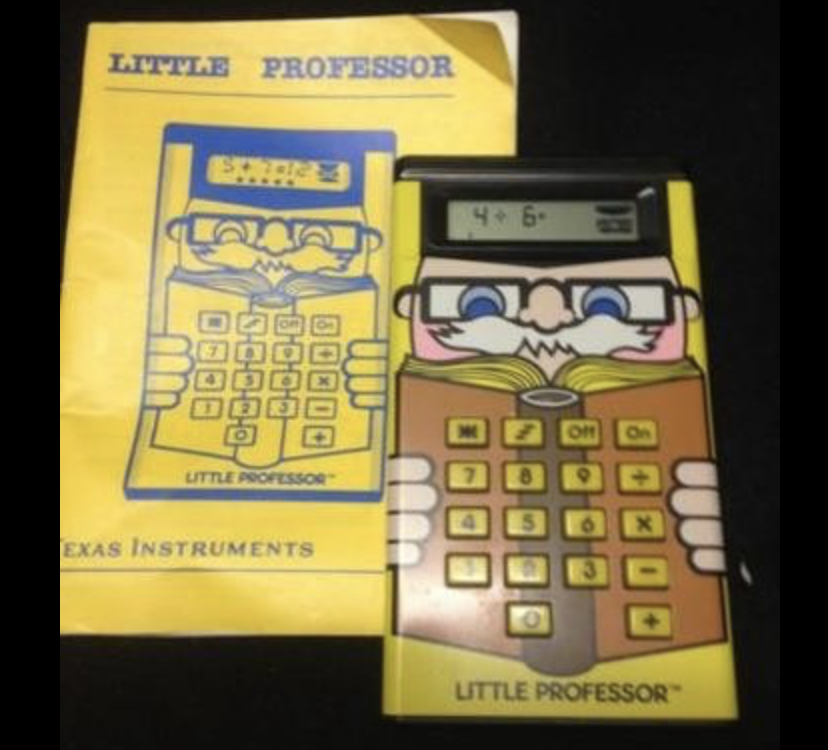
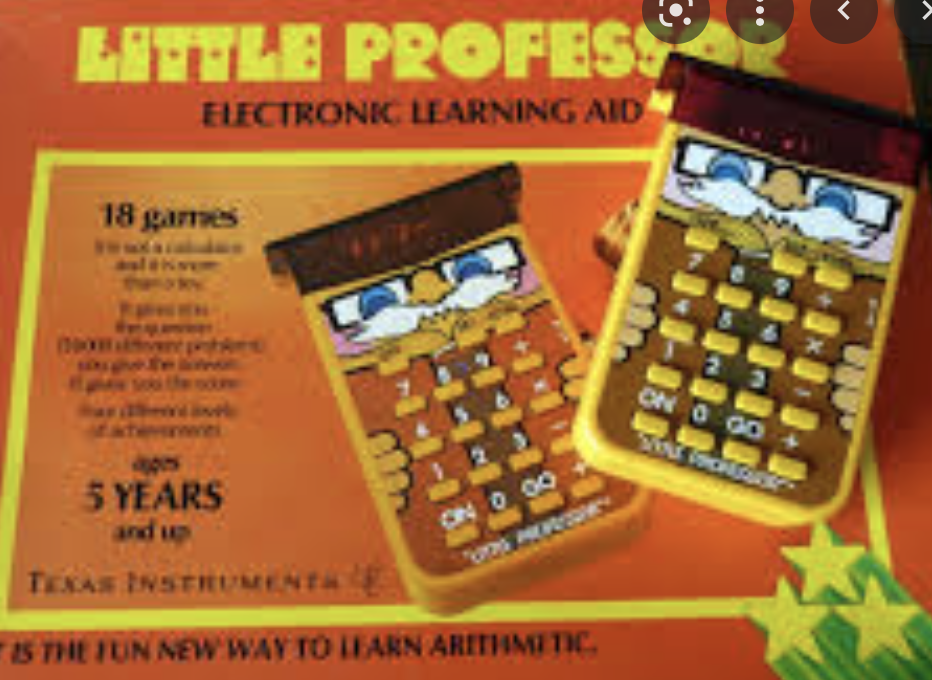
However, the one toy that summed up the child that I was, in the main, was a small yellow electronic calculator, called ‘The Little Professor’ . I was given one at the age of about 5 I think.
I learned quickly that I had to be clever. I wasnt going to be happy, neither felt in any way physically tough or handsome, and as I have said before, I was having to adapt to the systems around me, and also try and understand in it all. Words like conscientious on a good school report or ‘don’t try and be a clever clogs’ on a bad parent reaction day – were common. I learned to find safety in learning. I learned that I was going to have to try and work things out. Try and work out how to do well, how to survive, and even, as I said in this piece, how to work out how to get what I needed, without getting caught…
The little professors, the thinker, perceptive to have to work things out.
Some of it paid off, 4 years of home based little professor and my maths grades at Primary school were the very top. I was intelligent but utterly messy with it, untidy – I didn’t present what I knew well, but I knew things. Oh and I also worked out how to win the Little Bowden School story cup, by copying Martyn Buzzards story, he won by having a dog go on an adventure, I won the next month by having a cat do the same. Teachers couldn’t believe that I would cheat? I didnt cheat, I copied the good idea and turned it into my own. Clever. And maybe sweet and innocent too.
Little James had a very strong little professor – always thinking, trying to work things out, and in the case of this..
I was able to self learn all the times tables, all the sums, and began to memorise complicated sums like 27*37 which is 999 because the display on the little professor only had went up to 999 and so I wanted to work out what sum went to the highest number. There were many games on it, and most of the time I was doing very quick multiplication of double figures, the kind that id only learn to do properly in school many years later.
The ironic thing about the little professor in me, is that numbers was safe. I had no life experience aged 5,6,7,8,9 to fit with the things I was trying to find out, my mind was exploring, and wanting to know answers to questions, but id end up being seriously naive at times. It makes sense in another way too though, because I had to already know intuitively how to navigate eggshells, I had to be perceptive, always. Its no wonder I wanted to do psychology at the age of 16, its as if I knew something about reading other people. Sometimes that Little Professor was creative and innovative – sometimes it still is, and so I am very grateful for my little professor childhood survival strategy, going into my head and valuing learning and intelligence was what I needed to do to survive. Both to do well at school and thrive, and also to understand how to get what I needed, even if was devious.
I may come back to my ‘little professor’ childhood again, but there’s no doubt that in the midst of emotional neglect and abuse, the one thing that did develop , maybe too much, and detrimentally in later life – was that little professor part of my childhood development.


 James Ballantyne
Leave a reply to christellelerryn Cancel reply